Learn Poker GTO: Strategies, Tools, and Misconceptions Explained
GTO stands for: “Game Theory Optimal”. In recent years, the GTO concept has become very popular in poker. The goal of the GTO poker strategy is to play your game in a way that makes it impossible for your opponents to take advantage of any weaknesses.
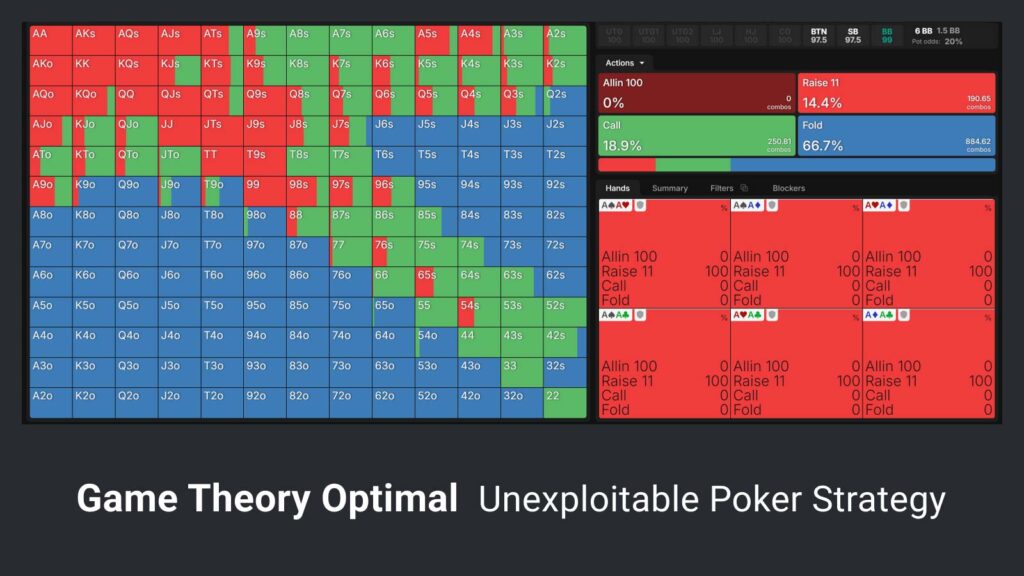
A player who uses a GTO strategy is amazingly good at making multiple plays with the same frequency, ensuring they always win or at least don’t lose, no matter what their opponents do.
Basics of GTO Poker
To understand GTO poker, you need to understand the ⚖️ Nash Equilibrium. Here’s a simple example to show what I mean:
- Player A bets the full pot on the river first, mixing 80% bluffs and 20% value hands.
- To counter this, Player B calls all river bets.
- Player A changes their strategy and now bets 75% value hands and 25% bluffs.
- Consequently, Player B starts to fold up to 70% of river bets.
- Player A changes even more, now having a spread of 66% value hands and 33% bluffs.
- Player B folds in response to 50% of the river bets.
The Nash Equilibrium has been reached for both players’ plans at this point. That is, neither player can change their plan to make their Expected Value go up. For every bluff that Player A makes, Player B wins more when they call. For every fold that Player B makes, Player A wins more when they bluff.
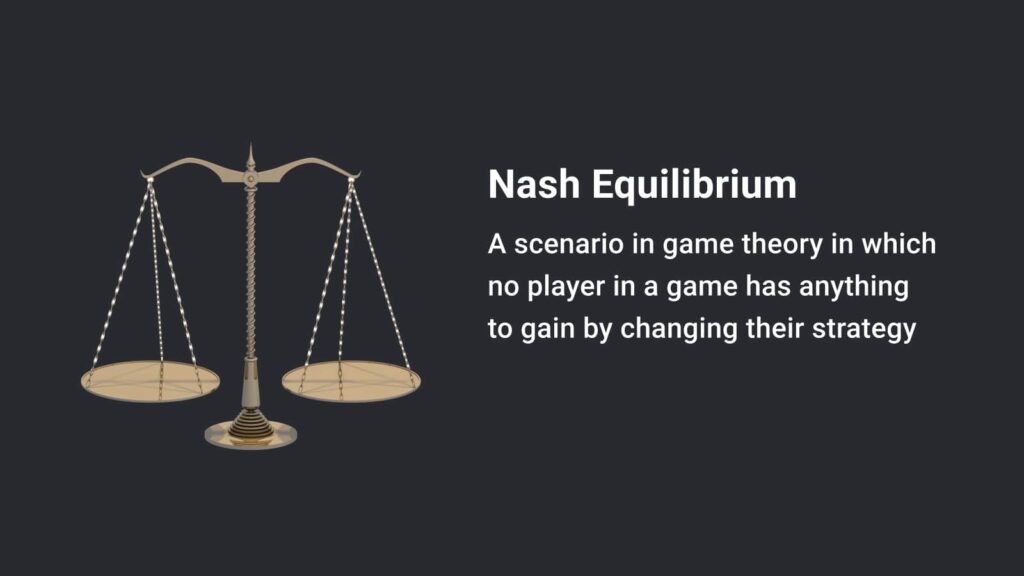
When you run a GTO solver software, it looks at every scenario that could happen if you make each strategic choice. This is done to find the Nash equilibrium.
Minimum Defense Frequency
Every professional player needs to know about minimum defense frequency. It shows the number of hands you need to keep playing for being unexploitable. That means, to prevent your opponents from taking any advantage of your game.
Intuitively, Minimum Defense Frequency (MDF) depends on the size of the opponent’s bet. When you are facing bigger bets, most players know it’s best to call with fewer hands. If you encounter small bets, you can continue with much more hands.
💡 To calculate your MDF, use this formula: MDF = Pot Size / (Pot Size + Bet Size)
For instance, your opponent bets $50 and the pot is $100. The MDF is 100 / (100 + 50) = 67%. It means you should keep going with 67% of your hands. So if you follow a perfect GTO play, you must play fold 33% of the time and continue with the remaining 67%. These hands you can call or raise.
It is best to think about your range of hands when you use the GTO poker strategy, and how it changes with each new street and action you and your opponents make.
Once you know how many hands you are supposed to fold to the opponent’s bet, you need to figure out what kinds of hands you keep going with. Typically you want to continue with your strongest hands, while also adding some marginal hands that have a good chance of improving on future streets.
GTO Defense Example
Let’s consider an example of a Big Blind GTO defense against a continuation bet from the Button on the A♠ 9♥ 8♥ board.
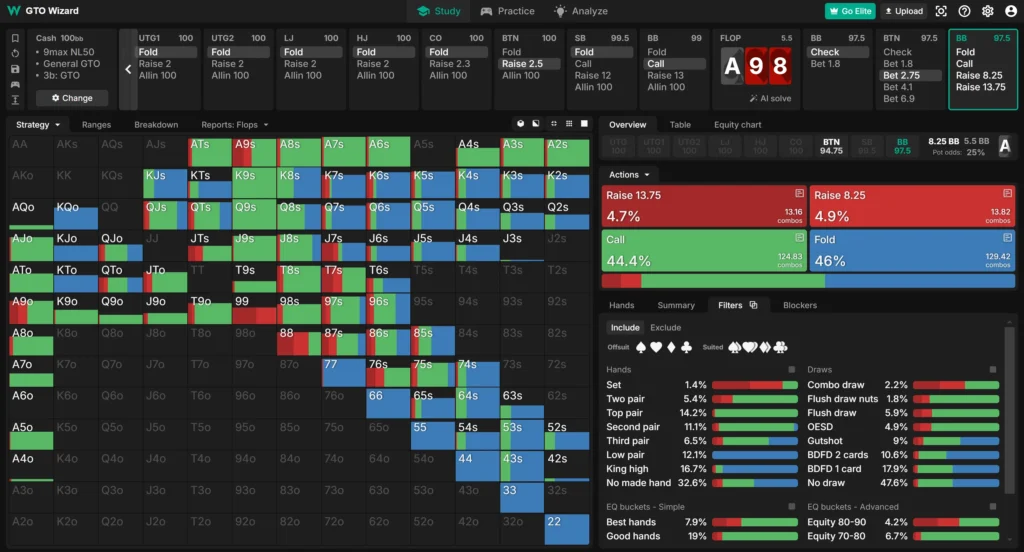
As you can see, we should raise in 9.6%, call in 44.4%, and fold in 46% cases.
Having a Balanced Range
The main idea behind GTO poker is to always be in balance. To be balanced when you bet or raise, you have to figure out two things:
- ❓ What is the perfect ratio between value bets and bluffs?
- ❓ What types of hands are best for bluffing in what situations?
The answers to these questions will in turn depend on various parameters of the hand:
- The size of the pot and the bet sizes
- Stack-to-pot ratio (SPR)
- The board texture
- The number of players in the hand.
Players often trust their guts to construct their ranges, but our feelings may not be optimal. As a result, your ranges will be unbalanced and your opponents will be able to exploit you easily.
It is very important to use solvers to analyze different scenarios. They could help us get over our worries and choose the optimal play. GTO solvers will always try to find the best number of hands to value bet with and the best number of hands to bluff based on the bet sizing and community cards you set.
GTO Continuation Bet Example
Let’s take a look at the example of a balanced continuation bet range. We’ll take the same situation from the previous example, but now we’ll see it from the Button point of view. So the continuation bet from the Button against a Big Blind looks like that:
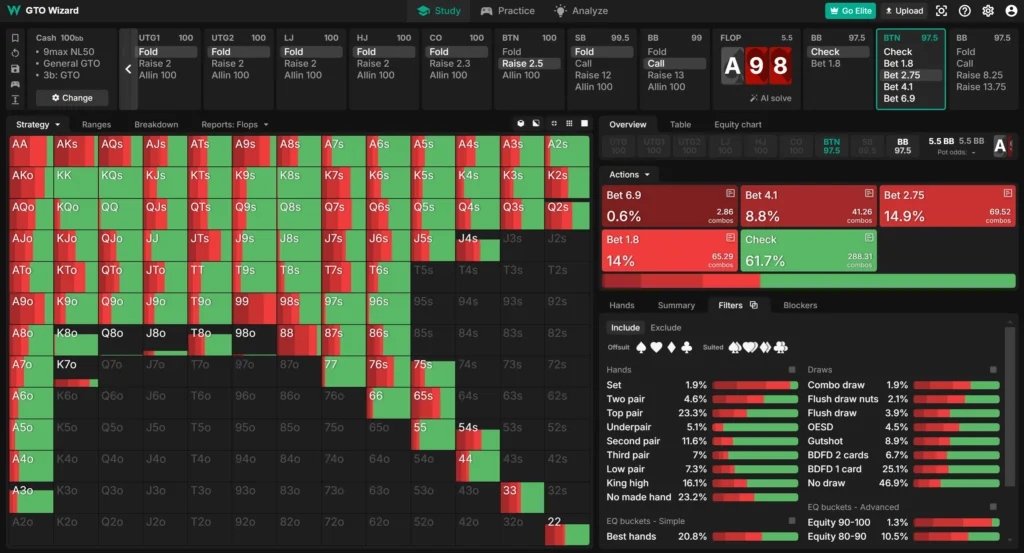
In this particular spot, our betting frequency is not that high. We bet only 38.3% of the time, while we prefer to check 61.7% of the time.
GTO Poker Tools
Players who are serious about poker often use GTO tools to study poker theory. This software uses complicated math and models to figure out the best way to play in every possible spot, and teach you about GTO concepts. We’ll review the best GTO tools you can use to improve your GTO knowledge.
Free GTO preflop tools
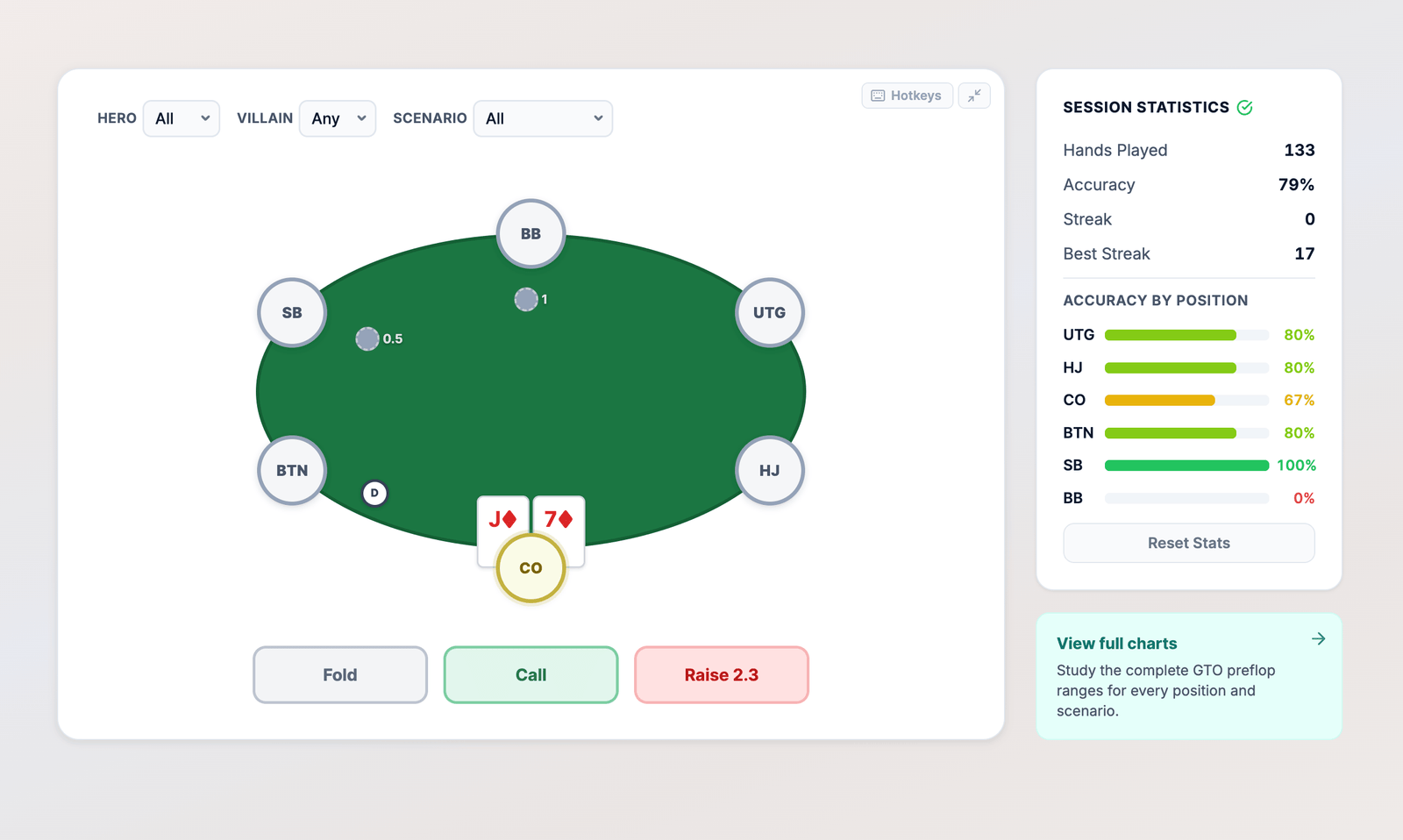
Simple preflop tools designed for you to learn the very basics of GTO play. Use Preflop GTO Charts to learn baseline GTO ranges by position and scenario. Then use Preflop GTO Trainer to drill those spots quickly and track your accuracy. For deeper GTO study, explore the advanced tools below.
GTO Wizard
One of the best ways to learn GTO poker strategies is to use the GTO Wizard tool. It’s the most popular GTO software on the market, and it is also the most modern and convenient. This is the app we used to show you examples of GTO ranges above.

Unlike old-fashioned solvers, you do not need to install anything on your computer and run calculations. The GTO Wizard application works in the browser and is very easy to navigate, including for beginners.
Key Features of GTO Wizard
- 🎓 Study: Explore almost any game spot from a GTO perspective, with a library of 10,000,000+ pre-solved situations. You only need to set an action and the community cards using a smooth interface, and you’ll see GTO ranges breakdown for all the players.
- 🎮 Practice: Challenge your GTO knowledge with a special trainer. You’ll have to make decisions at the table against GTO opponents. All your decisions will be estimated, again, from a GTO perspective.
- 💡 Analyze: Upload your hand history and analyze all the mistakes you made, from a GTO point of view.
Learn more about this tool in our GTO Wizard Overview article. Note that you can also get a 10% discount and a bonus on your first GTO Wizard subscription purchase.
Freebetrange
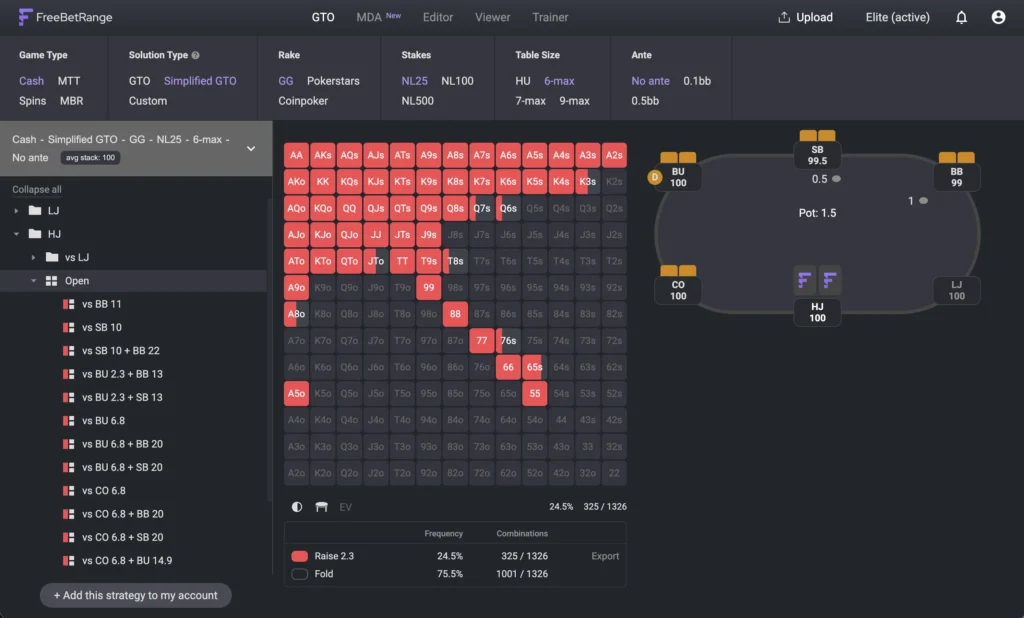
Freebetrange (FBR) is a browser-based platform focused entirely on preflop GTO study and training. Preflop is one of the most important streets, because this is where you lay the foundation for your entire strategy — and many tournament formats at short stacks are almost entirely preflop.
Key Features of Freebetrange
- GTO Library: Ready-made GTO preflop ranges for all major formats — Cash, MTT, Spin&Go, and MBR. Quickly review strategy in any spot, or add a chart to your account for further customization.
- MDA (Mass Data Analysis): Population preflop ranges built from real hand histories. Filter by game conditions and player type, and see how the field actually plays — the perfect complement to GTO study for building exploit strategies.
- Trainer: A fast and convenient preflop trainer. Pick any spot from the library in a couple of clicks and start practicing immediately. Two modes available: classic hand-by-hand decisions, and range-drawing from memory.
Learn more about this tool in our Freebetrange Overview article.
PioSOLVER
Piosolver is a classic solver that you install on your computer and run calculations yourself for any situation you configure. The PioSOLVER engine quickly handles all the possible outcomes of a postflop poker game, with custom ranges, stack sizes, and bet sizes.
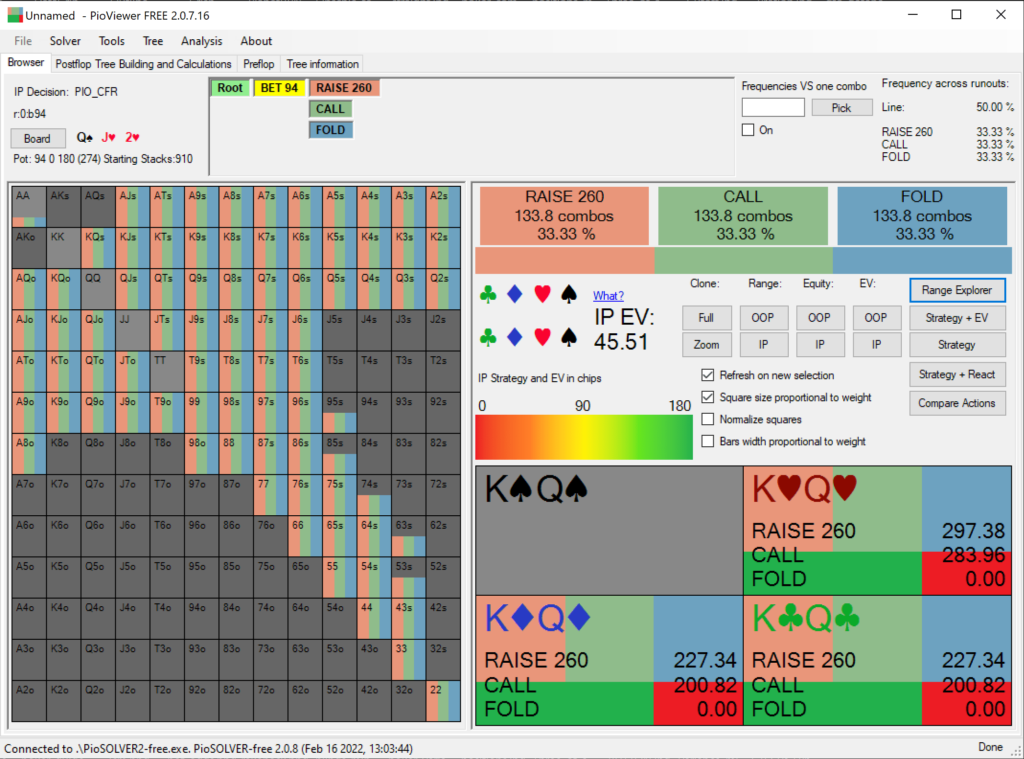
PioSOLVER features:
- Fast and accurate calculations for the Flop, Turn, and River;
- PioVIEWER tool for your solutions visualization;
- Building, saving, and loading strategy trees;
- Equity charts;
- and more.
PioSOLVER is a strong program that can correctly figure out Nash equilibrium in complex post-flop situations, such as on the Turn and the River. If you’re an advanced player, and the GTO Wizard library of solutions is not enough for you, you can consider getting PioSolver to run custom calculations on your device.
Commonly Misunderstood Aspects of GTO Poker
A great deal of information and conversations have been made about GTO since it became popular in the poker world, but many of them are wrong. We want to clear up the usual misconceptions about GTO poker and give you the correct information.
❌ You should play perfect GTO to win at poker
This is the biggest misconception of beginner players. Many people think that they can learn GTO ranges and start winning crazy money. In practice, this is not the case.
👉 GTO strategy is an ideal game plan only if your opponents also play GTO. If everyone played GTO, no one would make money except for the poker rooms that receive their commission (rake) from the games they host.
There is another fundamental approach to the game – Exploit. By studying the tendencies of your opponents, you can create an exploitative strategy to make money from their mistakes. Check out our article about Mass Data Analysis in poker to learn more about analyzing the player’s pool.
You can only become a successful player at high stakes by combining the GTO and MDA approaches.
❌ The same strategy can be applied in multiple scenarios
Many people think that certain GTO ideas can be used in any situation. Please keep in mind that the solver’s strategy can change based on many factors. If it plays one way in one situation, it doesn’t play the same way in another similar situation.
You may start to find some patterns as you study GTO. And this is an important part of learning to shape a GTO picture in your head. However, remember that the GTO strategy is very diverse, and you will need to study thousands of situations to learn to think like a solver.
❌ GTO Poker is only applicable in High Stakes
Players who play at all stake levels, not just those with high stakes, can use GTO tactics or at least should understand its basis. It is highly recommended that you learn GTO methods and use them when you face an opponent you are not familiar with, no matter the stakes involved.
Others say that GTO (Game Theory Optimal) methods shouldn’t be used when playing less experienced opponents at lower stakes. Based on their point of view, the best way to win is to take full advantage of weaker players’ flaws instead of using Game Theory Optimal (GTO) tactics. They make a good point. However, it’s important to think about how to take advantage of a person without knowing how they play.
If you make GTO tactics your default strategy, you can carefully watch your opponents and spot any mistakes they might make while lowering your own chances of making mistakes. Once you know what your opponent did wrong, you can change your strategy to take advantage of their flaws.
GTO Poker vs Exploitative Play
As we’ve already said, GTO Poker’s main goals are to make sure that our game can’t be exploited and that we are always balanced.
Exploitative poker is all about making money off of other people’s mistakes. We might have to give up some balance in our strategies to take advantage of their mistakes. The tricky part is: when we do that, we become exploitative too 🤷♂️

When we play exploitative poker, finding leaks in our opponent’s game can greatly help us. We need to be careful, though, because this strategy can leave us open to being used against us and beaten if our opponents find our leaks.
Against strong players who follow GTO principles, we will also have to follow GTO in most situations. A weaker opponent can help us win more often if we switch to an exploitative style of poker. As long as we don’t make any big mistakes that cost us a lot of money.
💡 Good players effectively combine GTO and Exploit approaches. Use the GTO strategy as a base against unknown and strong opponents. As soon as you start to notice specific leaks in your opponents’ game, start to shift away from the GTO ranges to profit from their mistakes. Remember that shifting away from the GTO strategy also makes you vulnerable, so use this approach with caution.
The higher the limit, the more you need to think about your own ranges, since your opponents are also carefully watching your mistakes. At low stakes, you can focus almost entirely on exploit. The level of play is very low, and almost no one follows GTO frequencies. However, understanding the concepts of GTO will help you gain an edge over the field even at low stakes. You will understand how much and in what situations your opponents deviate from the GTO the most. So you will be able to effectively exploit their mistakes.
How To Start Studying GTO?
No one plays perfect GTO — the game is too complex for a human to handle every frequency and every spot correctly. But that’s not the goal. The goal is to gradually learn GTO concepts, memorize the most important patterns, and build a solid baseline strategy that you can adjust at the tables.
Here’s a practical step-by-step plan we recommend:
Step 1. Start with free preflop tools
Begin with our free preflop tools — no subscription, no downloads, everything runs in the browser:
- Preflop GTO Charts — an interactive library with 35+ scenarios. Learn the baseline GTO ranges for every position and action.
- Preflop GTO Trainer — drill those ranges with instant feedback and accuracy tracking by position.
This is the fastest way to get familiar with GTO preflop ranges and build your first memory of the frequencies.
Step 2. Go deeper into preflop with Freebetrange
Once you understand the basics, move to Freebetrange for serious preflop work.
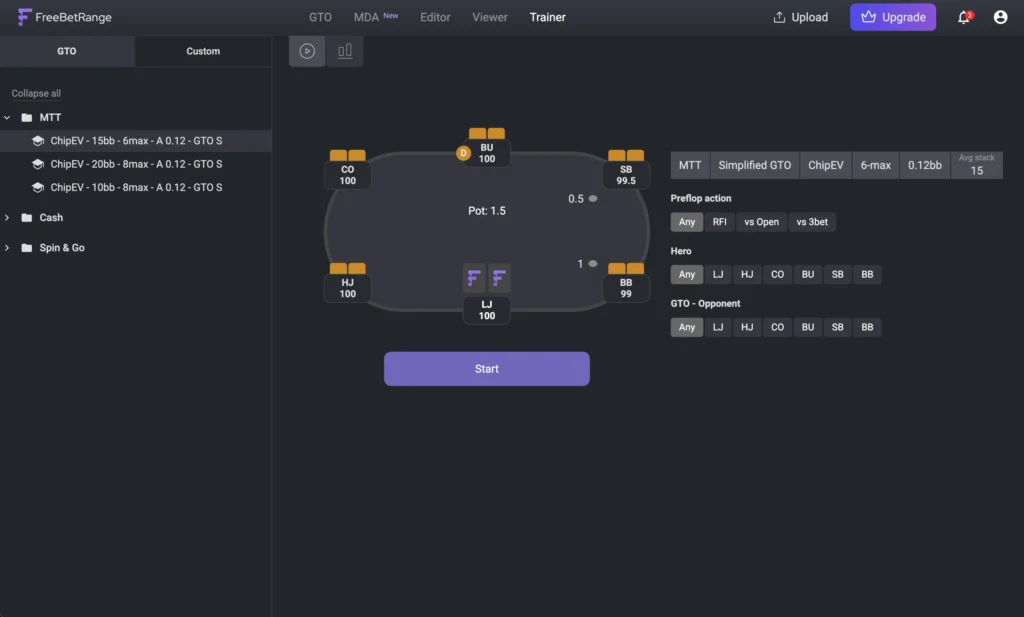
FBR gives you everything you need to turn preflop theory into a real, workable strategy:
- Use the built-in GTO Library for Cash, MTT, Spin&Go, and MBR.
- Customize and simplify GTO charts to make them practical at the tables.
- Train your ranges until they become automatic.
- Study MDA (population ranges) to see how the field actually plays and where you can deviate from GTO to exploit it.
By the end of this step, you’ll have a full preflop strategy that’s both GTO-based and ready for real play.
Step 3. Study postflop with GTO Wizard
Once preflop is under control, it’s time to move to postflop. GTO Wizard is the best place to start: a library of 10,000,000+ pre-solved spots, a convenient browser-based interface, and a trainer that lets you practice postflop decisions against GTO opponents.
A good approach is to review hands from your last session through GTO Wizard. These are spots you’ve actually played — your brain remembers them, so the lessons stick faster than studying random scenarios.
Summary
Game Theory Optimal (GTO) poker seeks to strike a balance that your opponents cannot exploit. Understanding the concept of GTO (Game Theory Optimal) can help you improve your overall poker game.
Human players may not be able to implement a perfect GTO strategy. However, tools like GTO Wizard, PIOSolver, and Freebetrange might enable them to achieve a simplified GTO strategy.
GTO is a fundamental part of poker theory. Every player should study the GTO concepts. However, playing pure GTO is not the best approach. The most money in poker is made from exploiting other players’ mistakes. So make sure to use poker HUD and explore the MDA approach to master that part of a strategy too.

Get GTO Wizard with exclusive discount and access to the most comprehensive GTO solver and training platform.
Get GTO Wizard Discount