Exploit Basics: Passive Player Profile
A passive player is, at first glance, the most straightforward type of opponent. They show aggression? That means bluffs are gone, and they’re only playing for value. But is it really that simple? How dangerous are these players, and where can we find profitable opportunities against them? What defines a passive player profile in poker, and which stats describe them?
In this article, we’ll take a detailed look at what a passive player’s stats look like in Holdem NL and analyze one specific hand scenario as an example.
Passive player statistics in Holdem NL
First, it’s important to understand which stats help identify a passive player. Among all available options, the most reliable indicators are Aggression Frequency Flop, Aggression Frequency Turn, and Aggression Frequency River.
Specifically, their values should be:
- Aggression Frequency Flop < 30%
- Aggression Frequency Turn < 30%
- Aggression Frequency River < 30%
To build a profile and gather stats for a passive player, we’ll use the “Multiple Players” tool in Hand2Note. We’ll follow the methods described in the article “The Multiple Players Tool in Hand2Note (Range Research)”.
For a more accurate and in-depth analysis, we’ll use a custom Hand2Note stat package called “Exploit HUD BASE.”
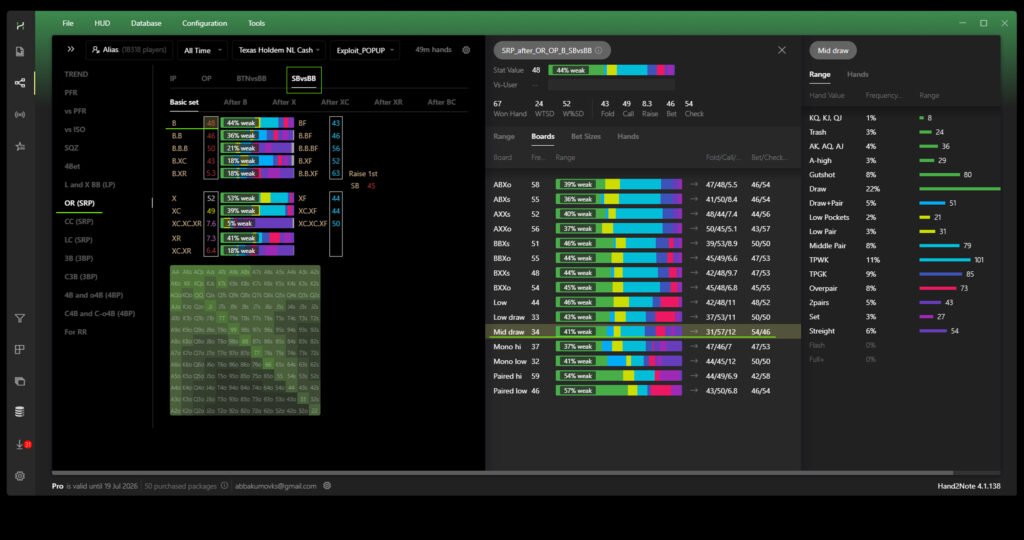
After building the required filter in Hand2Note’s “Multiple Players,” we can take a closer look at the passive player’s stats:
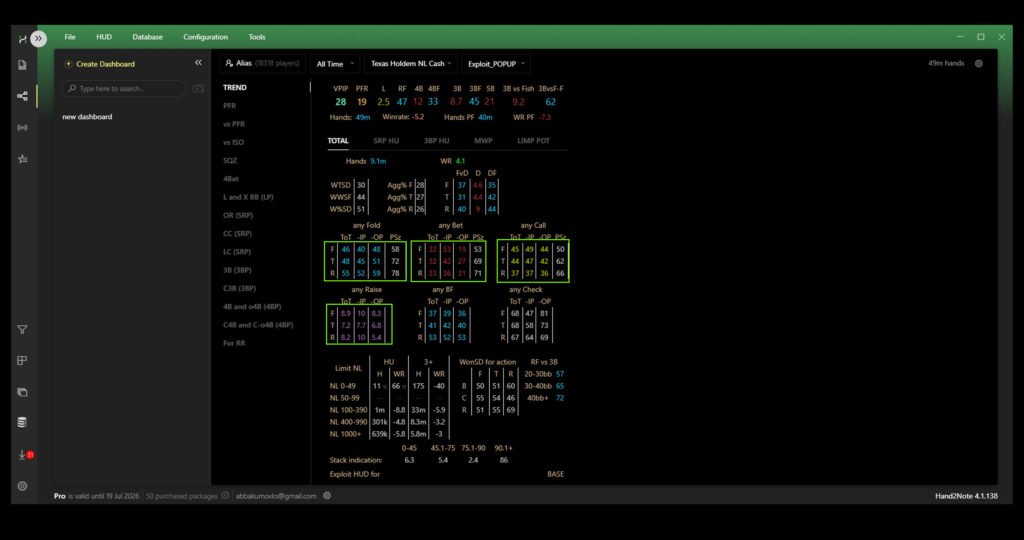
If we analyze the results carefully, we can highlight the key traits of a passive player:
- Low aggression: reflected in low betting and raising frequencies across all streets.
- A tendency toward “calling station” behavior, meaning frequent and often unjustified calls.
Analyzing strategy against a passive player’s flop c-bet
Let’s analyze how to play against a passive player’s c-bet using the following scenario: SB vs BB, single-raised pot, on a draw-heavy board (a board that allows for straight or flush draws). The strategy-building process will consist of several steps:
- defining preflop ranges for both players;
- determining hand strength ranges for the passive player’s flop actions;
- calculating equity and EV for flop decisions against a passive player.
Defining preflop ranges using FreeBetRange
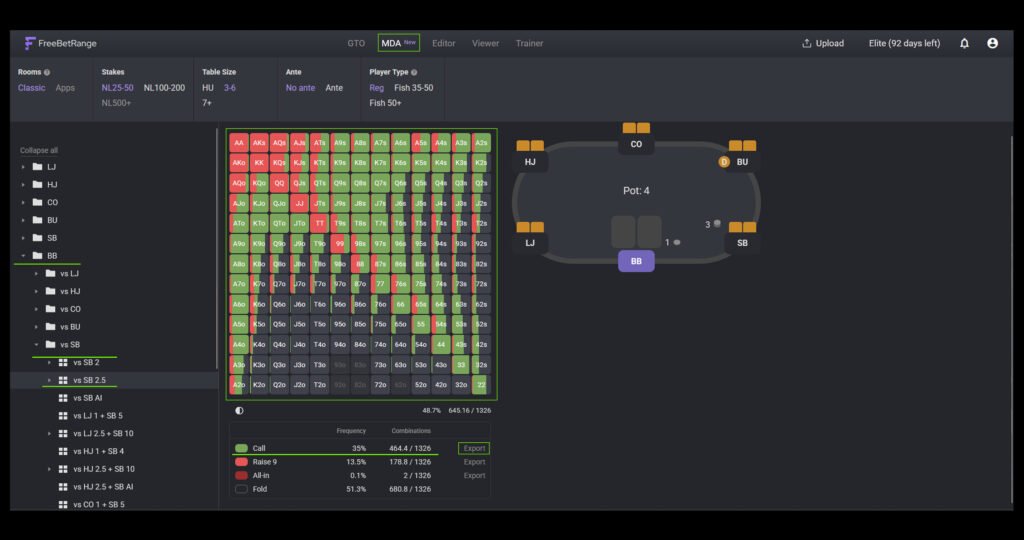
On the specialized preflop trainer website FreeBetRange, you can see typical calling and open-raising ranges for the positions we’re analyzing.
The BB calling range versus an SB open-raise will usually look like this:
And the SB open-raising range will typically look like this:
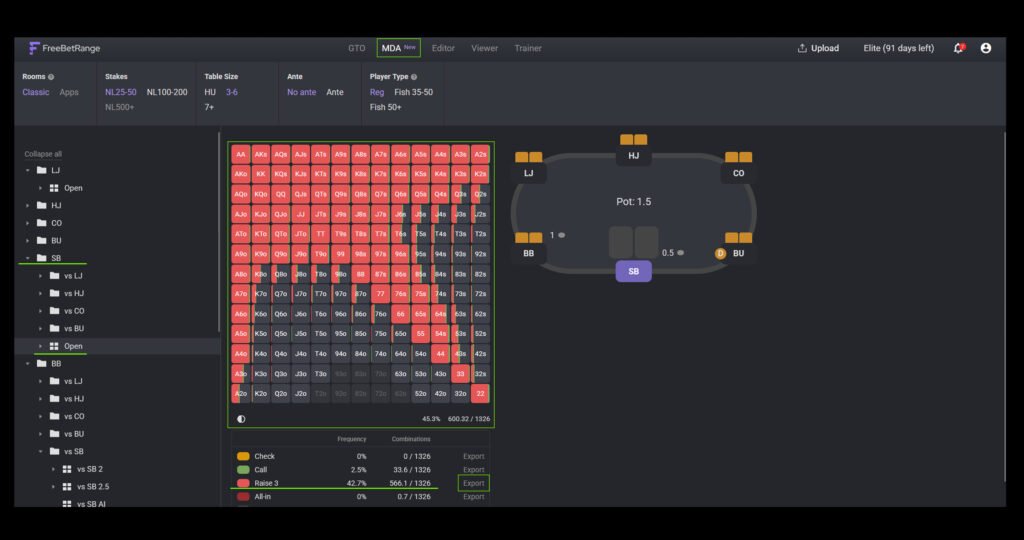
By clicking “Export,” you can copy the required preflop range to your clipboard.
Determining hand strength using FlopZilla
Next, we’ll use the poker calculator FlopZilla to speed up equity calculations. Import the preflop ranges using the “Export” function in FreeBetRange, then simplify the grid by rounding values: anything above 90% becomes 100%, and anything below 20% becomes 0%.
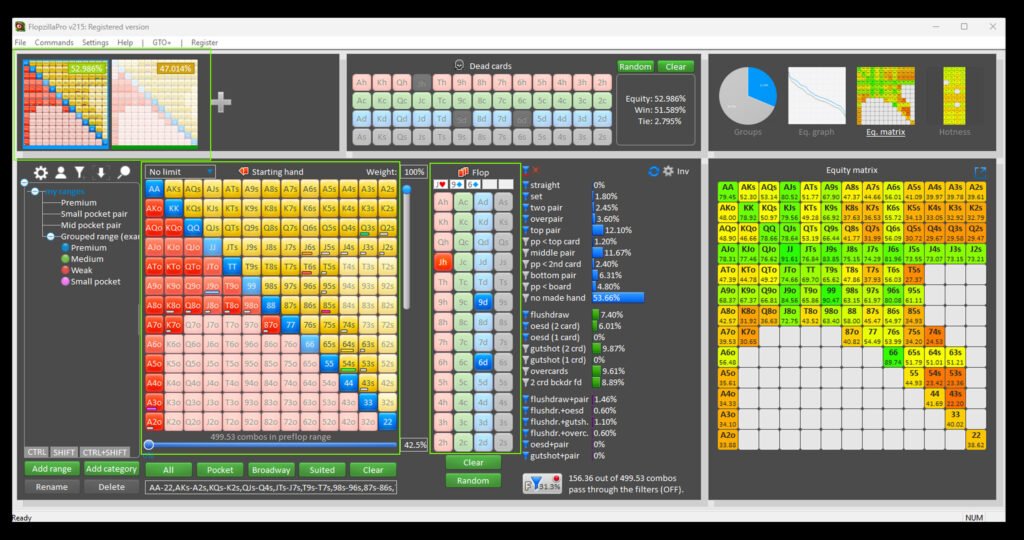
You’ll also need to set the flop. In our example: J♥ 9♦ 6♦.
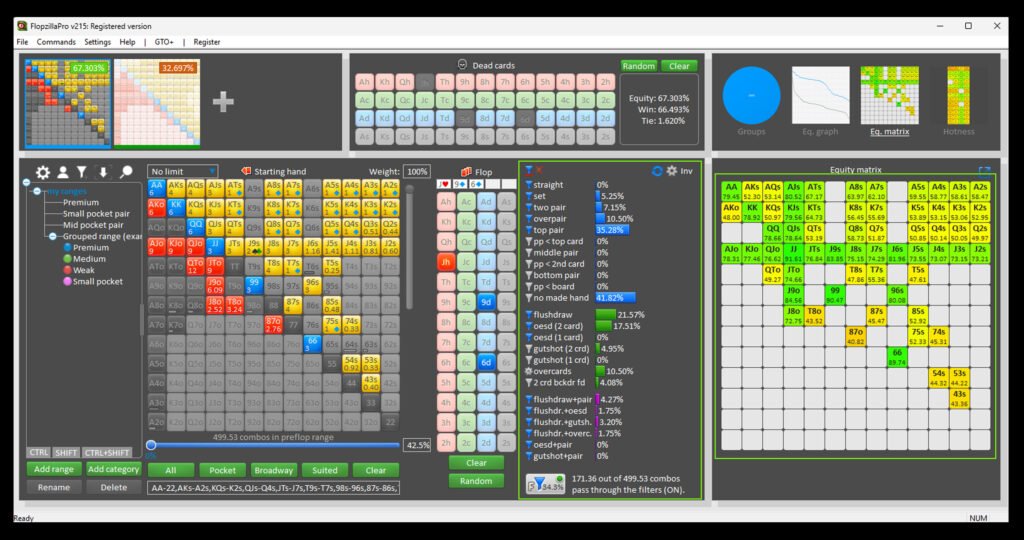
Now we уточнить the flop c-bet frequency for this scenario: SB vs BB on a medium, coordinated (draw-heavy) board. In this case, the value is 34%.
The next step is to lock the correct range in FlopZilla. If the frequency in the base filters doesn’t reach the required 34%, manually add hands. It’s best to rely on equity and include the strongest hands that weren’t part of the initial filters.
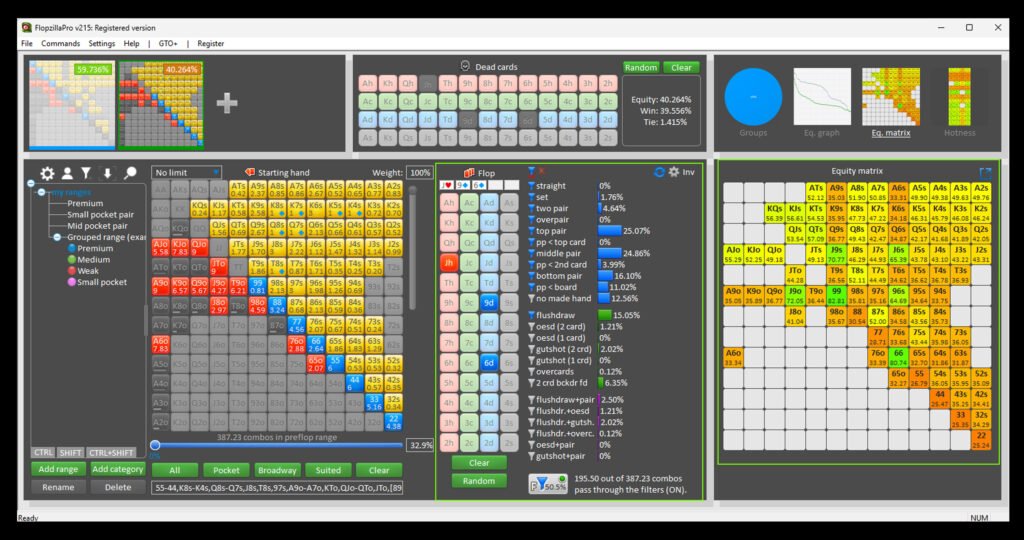
Next, move to the BB defense range and include the strongest hands, targeting an overall defense frequency of around 50%.
Equity calculation for different hand groups
The BB defense range can be divided into the following categories (equity percentages are rounded for clarity):
- Made hands:
- Set — 81% equity
- Two pair — 67% equity
- Top pair with a flush draw — 60% equity
- Top pair without a flush draw — 37% equity
- Second and third pair with a two-card backdoor flush draw — 35% equity
- Second and third pair without a two-card backdoor flush draw — 30% equity
- Pocket pairs below the second board card — 27% equity
- Drawing hands:
- Flush draw with overcards — 45% equity
- Flush draw without overcards — 35% equity
We could further refine the passive player’s betting range by sizing and hand strength, but we won’t go deeper into that math here. For this example, we’ll treat their entire betting range as using a single sizing.
EV calculation for calls and raises vs different bet sizes
Specialized formulas were used to calculate EV. Note that rake and rakeback are not included in this example.
EV Raise = ( Fold to raise * ( Bet + Pot ) ) - ( Call raise * Opponent equity * Raise ) + ( Call raise * Player equity * ( Bet + Pot ) ) - ( 3-bet vs raise * Raise )In this formula (EV Raise), the opponent’s equity when 3-betting the flop is assumed to be 100%.
EV Call = ( Player equity * ( Bet + Pot ) ) - ( Opponent equity * Bet )Initial data: fold to raise = 31%, call vs raise = 57%, flop 3-bet vs raise = 12%.
A set shows higher EV when calling than raising if the passive player’s bet size does not exceed the pot. Against overbet sizes, raising becomes preferable.
| vs Bet Size: | EV CALL: | EV RAISE: |
| BET 33% | 6,0876 | 4,09416 |
| BET 50% | 5,76 | 4,188 |
| BET 66% | 4,8096 | 4,27632 |
| BET 85% | 3,486 | 3,02175 |
| BET 100% | 2,64 | 2,925 |
| BET 125% | 0,27 | 2,76375 |
Two pair — EV is similarly strong for both calling and raising.
| vs Bet Size: | EV CALL: | EV RAISE: |
| BET 33% | 4,6932 | 4,09416 |
| BET 50% | 4,56 | 4,188 |
| BET 66% | 4,1136 | 4,27632 |
| BET 85% | 3,81 | 3,02175 |
| BET 100% | 2,64 | 2,925 |
| BET 125% | 1,53 | 2,76375 |
Top pair with a flush draw — also shows similar EV for both options. However, against bets larger than 100% of the pot, raising is better.
| vs Bet Size: | EV CALL: | EV RAISE: |
| BET 33% | 3,996 | 4,09416 |
| BET 50% | 3,84 | 4,188 |
| BET 66% | 3,4176 | 4,27632 |
| BET 85% | 3 | 3,02175 |
| BET 100% | 2,1 | 2,925 |
| BET 125% | 1,53 | 2,76375 |
Top pair without a flush draw — raising yields higher EV than calling.
| vs Bet Size: | EV CALL: | EV RAISE: |
| BET 33% | 1,7052 | 4,09416 |
| BET 50% | 1,44 | 4,188 |
| BET 66% | 0,6336 | 4,27632 |
| BET 85% | 0,246 | 3,02175 |
| BET 100% | -0,6 | 2,925 |
| BET 125% | -1,62 | 2,76375 |
Second and third pair with a two-card backdoor flush draw — raising is also preferable to calling.
| vs Bet Size: | EV CALL: | EV RAISE: |
| BET 33% | 1,506 | 4,09416 |
| BET 50% | 1,2 | 4,188 |
| BET 66% | 0,216 | 4,27632 |
| BET 85% | -0,24 | 3,02175 |
| BET 100% | -0,96 | 2,925 |
| BET 125% | -2,04 | 2,76375 |
Second and third pair without a backdoor flush draw — raising is more profitable than calling.
| vs Bet Size: | EV CALL: | EV RAISE: |
| BET 33% | 1,008 | 4,09416 |
| BET 50% | 0,6 | 4,188 |
| BET 66% | -0,2016 | 4,27632 |
| BET 85% | -0,726 | 3,02175 |
| BET 100% | -1,86 | 2,925 |
| BET 125% | -3,3 | 2,76375 |
Pocket pairs below the second board card — also better played as a raise.
| vs Bet Size: | EV CALL: | EV RAISE: |
| BET 33% | 0,7092 | 4,09416 |
| BET 50% | 0,24 | 4,188 |
| BET 66% | -0,48 | 4,27632 |
| BET 85% | -1,374 | 3,02175 |
| BET 100% | -2,4 | 2,925 |
| BET 125% | -3,72 | 2,76375 |
Conclusions
Since we didn’t account for rake or possible shifts in the passive player’s betting range strength, it’s better to follow a more conservative strategy:
- Set: the line isn’t critical — both raising (and calling a 3-bet) and calling are profitable.
- Two pair: call against bets smaller than the pot; raise (and call a 3-bet) against overbets.
- Top pair with a flush draw: vs bets up to 50% pot — both call and raise are fine (call vs 3-bet); vs 66–100% — prefer raising (call vs 3-bet); vs overbets — raise/fold to a 3-bet.
- Top pair without a flush draw: always raise; fold to a 3-bet.
- Second and third pair with a two-card backdoor flush draw: vs bets up to 85% pot — raise/fold to a 3-bet; vs larger bets — fold.
- Second and third pair without a two-card backdoor flush draw: vs bets up to 66% pot — raise/fold to a 3-bet; vs larger bets — fold.
- Pocket pairs below the second board card: vs bets up to 66% pot — raise/fold to a 3-bet; vs larger bets — fold.
- Flush draw with overcards: vs bets up to 100% pot — raise/fold to a 3-bet; vs larger bets — fold.
- Flush draw without overcards: vs bets up to 85% pot — raise/fold to a 3-bet; vs larger bets — fold.
It’s worth noting that these calculations are valid but highly simplified. Poker math is a powerful but complex tool that every serious player should master.
Overall, everything calculated above is just a foundation that requires further development: deeper EV calculations and planning future streets, as in this example. Strategy never ends with a single local decision — it always requires further refinement.
Finding the right poker strategy is like an internal dialogue:
— Okay, this is a +EV action. What’s next? How do we play the turn? The river? What about different runouts or bet sizes?
Final thoughts
A passive player is an opponent whose apparent simplicity is often deceptive. At first glance, it may seem enough to just stop bluffing and value bet relentlessly. However, in practice, an unstructured approach can lead to missed profits where you could have maximized value.
In this article, we showed how to mathematically confirm a player’s passivity using precise statistical filters (Aggression Frequency < 30%) in Hand2Note’s “Multiple Players” tool. More importantly, we demonstrated through a real example that the optimal strategy against such players requires flexibility: calling is not always the best option, even when you have a strong hand.
Analysis with FlopZilla and FreeBetRange shows that against passive opponents, the raising range (both raise/fold and raise/call lines) is significantly wider. The ability to correctly classify hands — from sets to draws — and adjust based on your opponent’s bet sizing allows you to turn a passive player’s tendency to overcall into your advantage.
Remember, these calculations are a foundation for building strategy, not a rigid rulebook. Poker only becomes a complete-information game over the long run.
Use this data for deeper analysis, consider hand context, and adapt your decisions to each specific opponent. Only a comprehensive approach — combining accurate stats, mathematical reasoning, and attention to your opponent’s actions across all streets — will allow you to effectively exploit passive players and steadily increase your win rate.
In future articles, we’ll analyze semi-aggressive and aggressive player types and learn how to automatically identify player profiles at the table using Hand2Note and the Badges tool.

Latest guides
-
 Exploit Basics: Passive Player Profile Apr 9, 2026
 -
 Hand2Note Popup Editor: Creating a Professional Popup Mar 28, 2026
 -
 Hand2Note Pro Pricing Reduced in 2026 Mar 19, 2026
 -
 How to Analyze Fish Ranges: Limp, Limp-Raise, and Limp-Fold Mar 13, 2026
 -
 Hand2Note Popup Editor: Creating a Simple Popup Mar 10, 2026
We regularly publish new Hand2Note 4 guides on our Discord server.
Join Discord Server