Exploit Fundamentals: The Moderately Aggressive Player Profile
Against a moderately aggressive opponent, things are not as straightforward as they are against a passive player. They bet made hands, bluff occasionally, and do not fold to the first bet they face—their play looks perfectly reasonable at first glance. There is no simple rule such as “never bluff against this player.” But how balanced is their play in reality? Where do they lose money, and which stats reveal these leaks?
We will start by looking at the stats that define a moderately aggressive player in Hold’em NL, and then calculate how to defend against their continuation bet in a specific hand. The positions are the same as in our analysis of the passive player profile—SB versus BB in a single-raised pot—but this time the board is dry and contains an ace.
Moderately aggressive player stats in Hold’em NL
To distinguish moderately aggressive players from the rest, we only need the same three stats we used for the passive profile: Aggression Frequency Flop, Aggression Frequency Turn, and Aggression Frequency River.
The filter for a moderately aggressive player looks like this:
- Aggression Frequency Flop—from 31% to 39%
- Aggression Frequency Turn—from 31% to 37%
- Aggression Frequency River—from 31% to 35%
We will build the sample in Hand2Note using the Multiple Players tool. The process is explained in detail in “The Multiple Players Tool in Hand2Note (Range Research)”; here, we only need to set the required aggression values.
We will examine the sample using the same custom “Exploit HUD BASE” stat package, which contains the stats needed specifically to identify exploits.
Once the filter has been set, Multiple Players displays aggregated stats for all matching players:
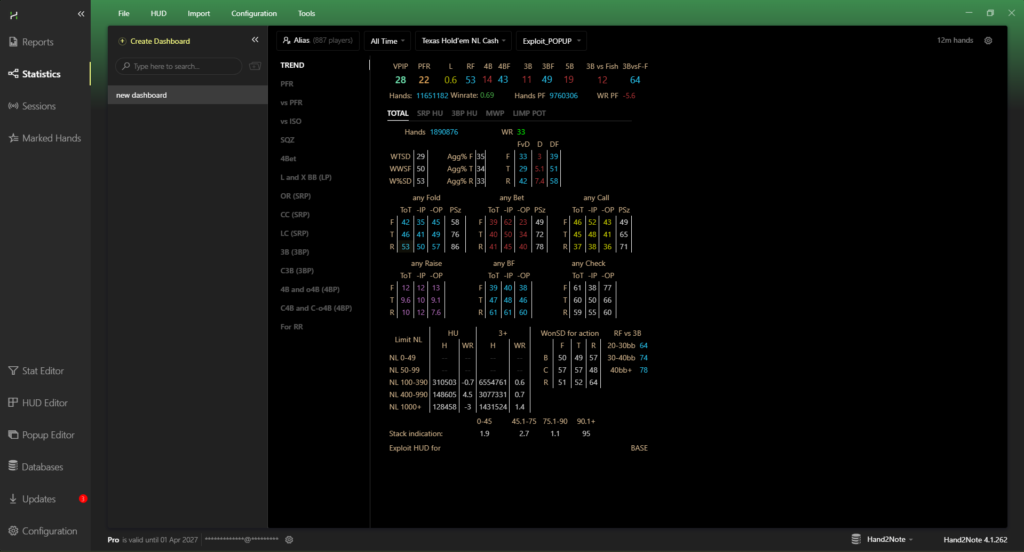
These numbers provide a fairly clear picture of a moderately aggressive player:
- Their aggression is moderate and consistent across all streets: Aggression Frequency ranges from 33% to 35% on the flop, turn, and river.
- They prefer betting in position: their flop betting frequency is 62% in position but only 23% out of position.
- Their bets become larger by the river: approximately 49% of the pot on average on the flop, 72% on the turn, and 78% on the river.
- They rarely raise and become increasingly likely to give up when raised on later streets: their own raising frequency is 12% on the flop and around 10% on both the turn and river, while after betting they fold to a raise 39% of the time on the flop, 47% on the turn, and 61% on the river.
On the flop, this type of player still stands up to aggression, but by the river they become much more willing to give up the pot. This means our decisions against them depend on the street: a play that works on the river may be a mistake on the flop.
Analyzing a strategy against a moderately aggressive player’s flop continuation bet
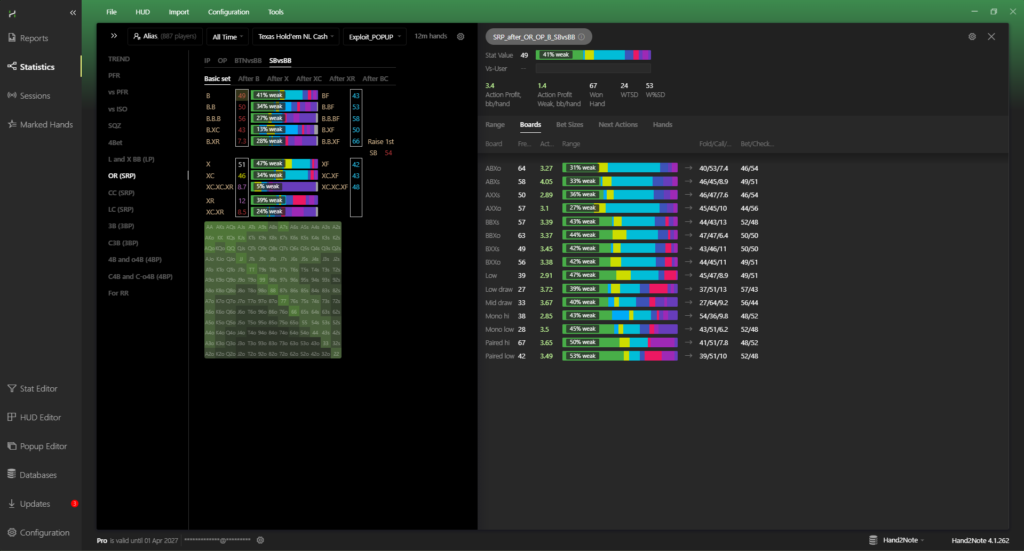
As an example, we will use an SB-versus-BB hand in a single-raised pot on an A♥ Q♣ 5♠ flop. Hand2Note classifies boards like this as ABXo: an ace, a Broadway card, and a low card, all of different suits.
Our opponent is noticeably more active on this texture than they are on average. They make a continuation bet from the SB against the BB 49% of the time across all boards, but 64% on ABXo boards. When raised, they fold 40% of the time, call 53%, and 3-bet 7.4%. If their continuation bet is called, they keep betting on the turn only 46% of the time and check the remaining 54%.
According to Hand2Note’s estimate, around 31% of their continuation bets on ABXo boards are made with weak hands. This is a guideline rather than an exact figure because the range composition is estimated from hands that went to showdown.
Developing our strategy involves three stages:
- find both players’ preflop ranges;
- determine which hands the moderately aggressive opponent bets on the flop and which hands we defend with;
- calculate the equity and EV of calling and raising against their continuation bet.
Determining the players’ preflop ranges with FreeBetRange
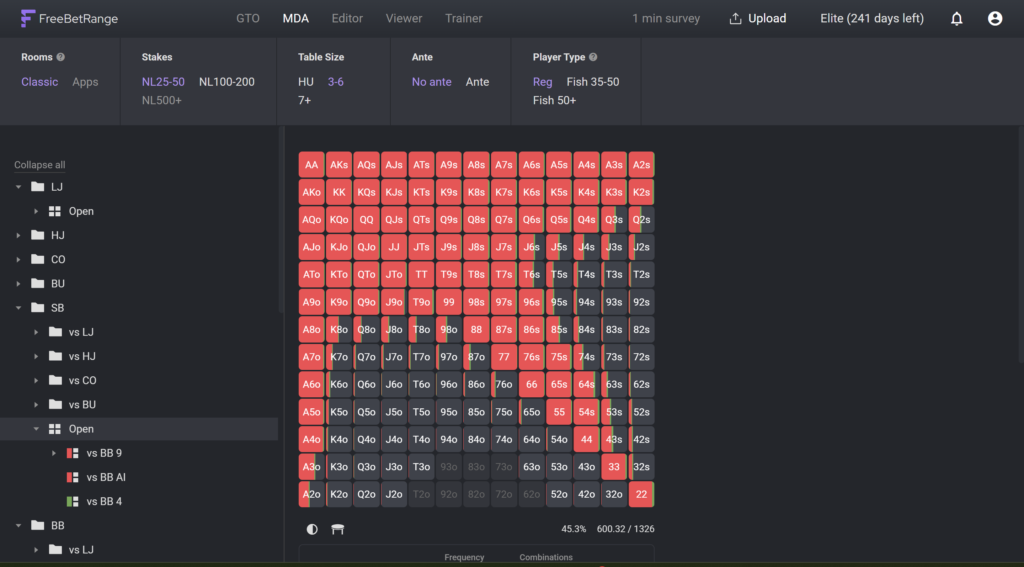
Actual field ranges, rather than theoretical ones, for the required positions are available in the MDA section of the FreeBetRange trainer. We use the following filters for this analysis: Classic rooms, NL25–50 stakes, 3–6 players, no ante, and Reg as the player type.
With these settings, players open from the SB against the BB with approximately 45% of hands:
Against a 2.5bb open from the SB, players in the BB continue with 48.7% of hands: some are played as a 3-bet, while the rest are called:
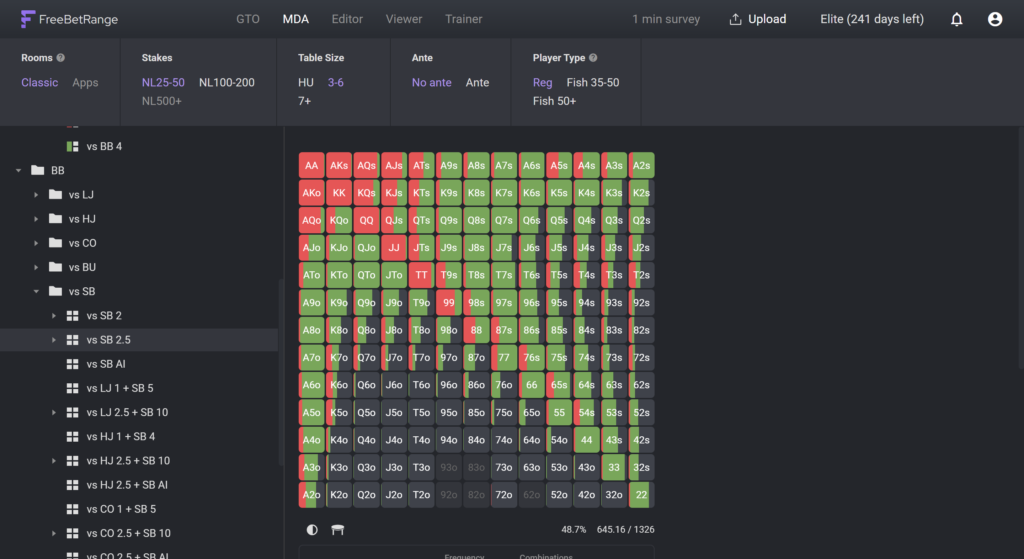
One detail is important here: the BB almost always 3-bets AK and AQ. As a result, the BB’s calling range contains few strong top pairs on an ace-high board—most of its aces have weak kickers.
Both ranges can be exported using the Export button, which copies them to the clipboard.
Determining hand strength with FlopZilla
We paste the ranges exported from FreeBetRange into FlopZilla and set the flop to A♥ Q♣ 5♠.
The moderately aggressive player makes a continuation bet on ABXo boards 64% of the time, so the SB’s betting range in FlopZilla should also account for 64% of their range. It includes all sets, two pair, and top pair, as well as KK, approximately half of their middle pairs and pocket pairs below the board’s second-highest card, some bottom pairs, and unpaired hands that make up around a quarter of the continuation-betting range.
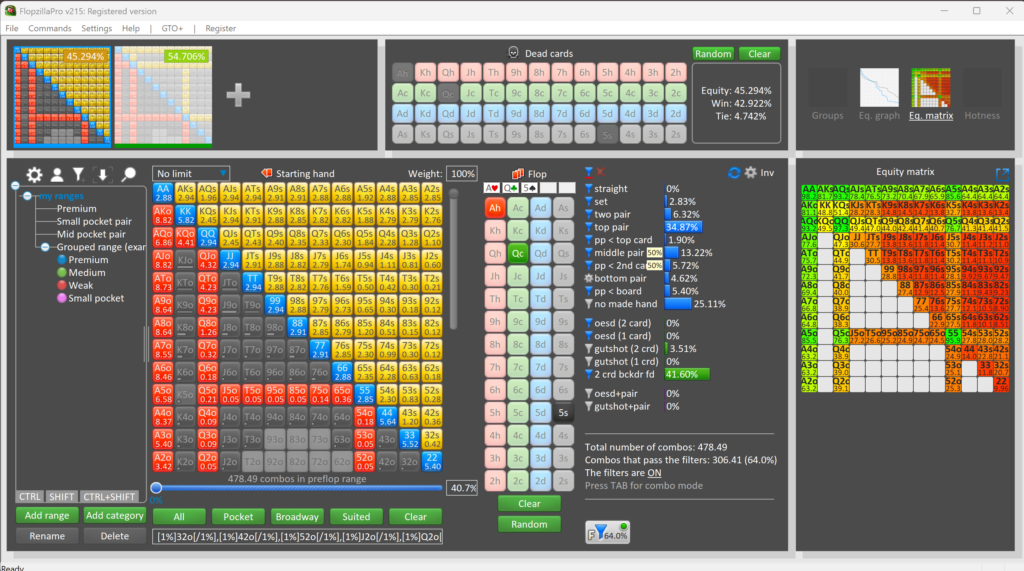
Next, we set up the BB’s defending range. The board is dry, so we continue with all hands that have a pair or better—exactly half of the calling range. Unpaired hands, including gutshots such as KJ, KT, and JT, are folded. Against the SB’s continuation bet, this defending range has 54.7% equity.
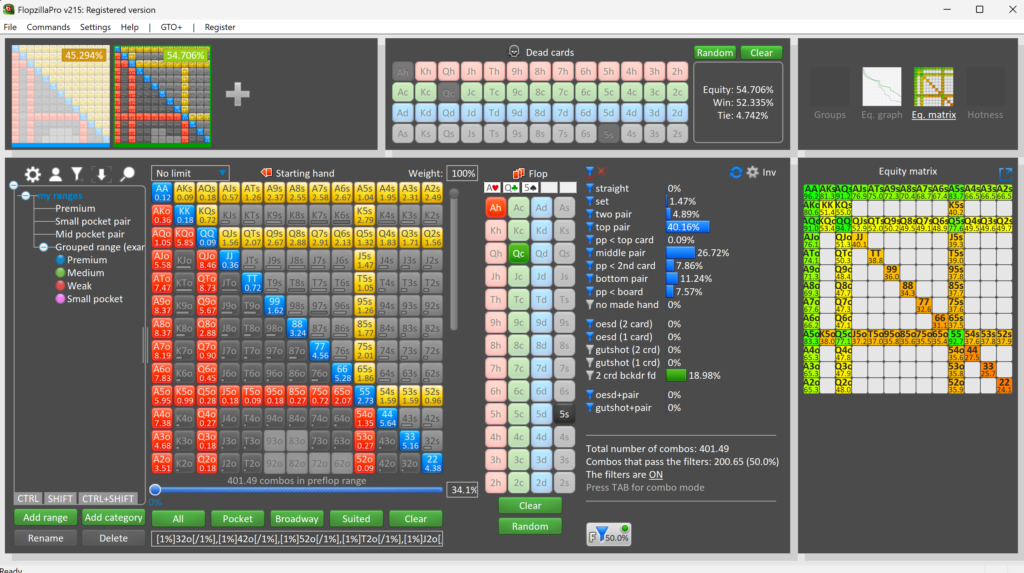
Calculating equity for different hand groups
We divide the BB’s defending range into hand groups and check each group’s equity against the full continuation-betting range. The values are rounded:
- Set (AA, QQ, 55)—93% equity
- Two pair (AQ, A5, Q5)—83% equity
- Top pair with a strong kicker (AK, AJ, AT)—75% equity
- Top pair with a weak kicker (A9–A2)—68% equity
- Middle pair (Qx) and KK—50% equity
- Pocket pairs below the board’s second-highest card (JJ–66)—33% equity
- Bottom pair (5x)—38% equity
- Pocket pairs below the board (44–22)—26% equity
There are no draws in this range: the dry board offers no flush draws or open-ended straight draws, while the BB folds unpaired hands.
These figures alone are not enough to evaluate a raise. The moderately aggressive player continues against a raise 60% of the time: 53% calls and 7.4% 3-bets. Top pair or better, along with KK and middle pairs, makes up 59% of their continuation-betting range—almost exactly the same amount. We can therefore conclude that when our raise is called, we are no longer facing the entire betting range, but only its stronger portion. To calculate our equity in this situation, we leave only sets, two pair, top pair, KK, and middle pairs in the SB’s range in FlopZilla and run the calculation again:
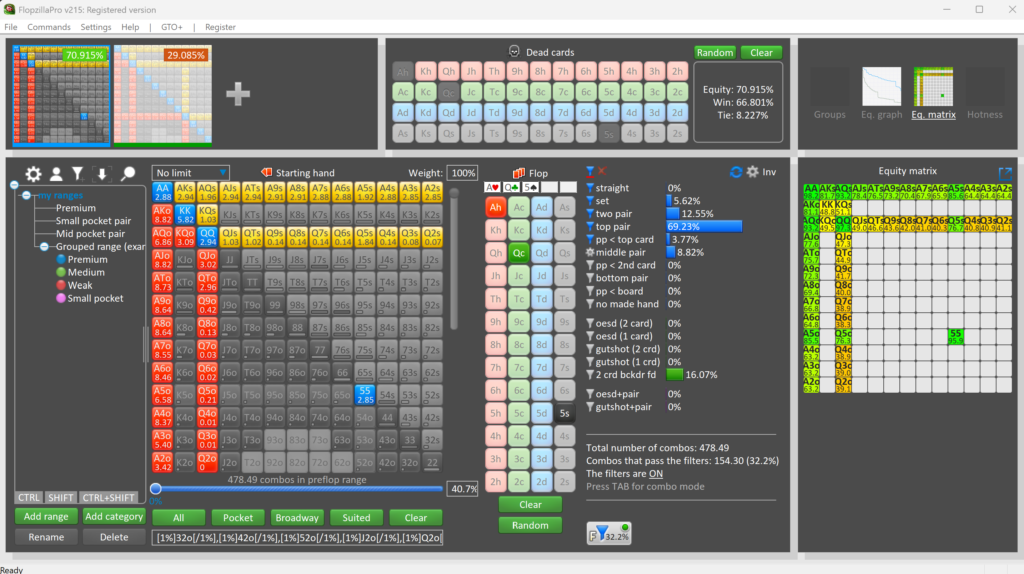
The equity of the same hand groups against the range that continues versus a raise:
- Set—92% equity
- Two pair—76% equity
- Top pair with a strong kicker—63% equity
- Top pair with a weak kicker—49% equity
- Middle pair and KK—22% equity
- Pocket pairs below the board’s second-highest card—8% equity
- Bottom pair—18% equity
- Pocket pairs below the board—10% equity
We do not separate different continuation-bet sizes within the range. We assume that the entire range uses one bet size and test several possible sizes.
Calculating the EV of calling and raising against different bet sizes
We calculate EV using two formulas, without accounting for rake or rakeback.
EV Call = (Player’s Probability of Winning * (Bet + Pot)) – (Opponent’s Probability of Winning * Bet)
EV Raise = (Probability of a Fold to the Raise * (Bet + Pot)) + (Probability of a Call to the Raise * (Equity When the Raise Is Called * (Pot + Raise) – (1 – Equity When the Raise Is Called) * Raise)) – (Probability of a 3-Bet Against the Raise * Raise)
“Equity When the Raise Is Called” in the EV Raise formula is the hand’s equity against the range that continues versus the raise. We fold to a 3-bet, so we lose the full amount of our raise in that branch.
The calculation uses the following assumptions:
- the pot on the flop is 5bb—a 2.5bb open-raise from the SB and a call from the BB;
- our raise size is three times the opponent’s bet;
- fold to raise is 40%, call raise is 53%, and 3-bet against a raise is 7.4%;
- EV is shown in big blinds.
Set: raising earns more than calling against every bet size. The formula also counts our raise as a loss when we face a 3-bet, but we would not fold a set to a 3-bet, so the actual EV of raising is even higher.
| vs. Bet Size | EV CALL | EV RAISE |
|---|---|---|
| BET 33% | 6.07 | 6.94 |
| BET 50% | 6.80 | 8.22 |
| BET 66% | 7.49 | 9.43 |
| BET 85% | 8.31 | 10.87 |
| BET 100% | 8.95 | 12.01 |
| BET 125% | 10.03 | 13.90 |
Two pair: raising outperforms calling against every bet size, and the larger the opponent’s bet, the greater the difference.
| vs. Bet Size | EV CALL | EV RAISE |
|---|---|---|
| BET 33% | 5.24 | 5.67 |
| BET 50% | 5.80 | 6.53 |
| BET 66% | 6.33 | 7.33 |
| BET 85% | 6.95 | 8.28 |
| BET 100% | 7.45 | 9.04 |
| BET 125% | 8.28 | 10.29 |
Top pair with a strong kicker: raising is slightly more profitable than calling, although the difference is small. This hand still has 63% equity against the range that continues versus a raise, which is enough to raise for value.
| vs. Bet Size | EV CALL | EV RAISE |
|---|---|---|
| BET 33% | 4.58 | 4.65 |
| BET 50% | 5.00 | 5.15 |
| BET 66% | 5.40 | 5.62 |
| BET 85% | 5.88 | 6.18 |
| BET 100% | 6.25 | 6.63 |
| BET 125% | 6.88 | 7.37 |
Top pair with a weak kicker: calling is more profitable. When we raise, the opponent’s weaker hands fold, while we have only 49% equity against the hands that continue.
| vs. Bet Size | EV CALL | EV RAISE |
|---|---|---|
| BET 33% | 3.99 | 3.54 |
| BET 50% | 4.30 | 3.66 |
| BET 66% | 4.59 | 3.78 |
| BET 85% | 4.93 | 3.92 |
| BET 100% | 5.20 | 4.03 |
| BET 125% | 5.65 | 4.21 |
Middle pair and KK: calling is more profitable against every bet size, while raising becomes unprofitable against bets of 85% pot or more. Because this group has exactly 50% equity, the EV of calling does not change with the bet size.
| vs. Bet Size | EV CALL | EV RAISE |
|---|---|---|
| BET 33% | 2.50 | 1.41 |
| BET 50% | 2.50 | 0.80 |
| BET 66% | 2.50 | 0.23 |
| BET 85% | 2.50 | -0.44 |
| BET 100% | 2.50 | -0.98 |
| BET 125% | 2.50 | -1.87 |
Pocket pairs below the board’s second-highest card: calling is more profitable than raising. Against bets of 100% pot or more, both options have negative EV.
| vs. Bet Size | EV CALL | EV RAISE |
|---|---|---|
| BET 33% | 1.09 | 0.30 |
| BET 50% | 0.80 | -0.68 |
| BET 66% | 0.53 | -1.61 |
| BET 85% | 0.21 | -2.71 |
| BET 100% | -0.05 | -3.58 |
| BET 125% | -0.47 | -5.02 |
Bottom pair: calling is more profitable against every bet size, while raising becomes unprofitable against bets of 66% pot or more.
| vs. Bet Size | EV CALL | EV RAISE |
|---|---|---|
| BET 33% | 1.50 | 1.09 |
| BET 50% | 1.30 | 0.38 |
| BET 66% | 1.11 | -0.29 |
| BET 85% | 0.88 | -1.09 |
| BET 100% | 0.70 | -1.72 |
| BET 125% | 0.40 | -2.77 |
Pocket pairs below the board: against a 33% pot bet, calling and raising produce almost identical results. Against a 50% pot bet, calling is barely above break-even, while both options have negative EV against larger bets.
| vs. Bet Size | EV CALL | EV RAISE |
|---|---|---|
| BET 33% | 0.51 | 0.46 |
| BET 50% | 0.10 | -0.47 |
| BET 66% | -0.28 | -1.35 |
| BET 85% | -0.74 | -2.38 |
| BET 100% | -1.10 | -3.21 |
| BET 125% | -1.70 | -4.57 |
Conclusions
The calculations do not account for rake, different continuation-bet sizes within the range, or turn and river play, so we should draw conservative conclusions from the tables:
- Set: raise against any bet size and call a 3-bet.
- Two pair: raise against any bet size and call a 3-bet.
- Top pair with a strong kicker: raising is slightly more profitable; fold to a 3-bet. Calling also remains profitable.
- Top pair with a weak kicker: call against any bet size.
- Middle pair and KK: call against any bet size.
- Pocket pairs below the board’s second-highest card: call against bets of up to 85% pot; fold against bets of 100% pot or more.
- Bottom pair: call against any bet size.
- Pocket pairs below the board: call against bets of up to 50% pot; fold against larger bets.
Therefore, against a moderately aggressive player in this hand, raising should primarily be used for value. The opponent calls a raise 53% of the time, so strong hands earn more by building the pot immediately. Bluff-raising weak pairs, however, is unprofitable: the opponent folds only 40% of the time, and these hands have almost no equity against the range that continues. Playing them as calls is more profitable—especially because the opponent checks the turn 54% of the time after their continuation bet is called, often allowing us to see the next card for free.
It is also important to understand the limitations of these figures. The EV call formula assumes that a hand realizes all of its equity. In practice, weak pairs out of position realize less than their full equity, so calling the weakest of them against large bets is even less profitable than the tables suggest. Conversely, the EV of raising with sets and two pair is understated because we do not fold these hands to a 3-bet.
The flop is only the first part of the hand. We need to perform the same calculations for the turn and river because a decision on one street does not provide a complete strategy for the entire hand.
Every decision leads to another question. Suppose we call with top pair and a weak kicker—what should we do next? On these boards, the opponent bets the turn only 46% of the time after their flop bet is called. Should we bet when they check the turn or check back? How should we defend if they do fire a second barrel? And how should we play two pair if they 3-bet our flop raise?
Final thoughts
A moderately aggressive player only appears balanced. Their aggression is moderate and strongly position-dependent. They still stand up to aggression on the flop, but by the river they increasingly fold to a raise after making a bet.
Aggression Frequency filters—from 31% to 39% on the flop, up to 37% on the turn, and up to 35% on the river—in Hand2Note’s Multiple Players tool identify this type of opponent and reveal their leaks in specific numbers. The hand analysis also clearly demonstrates that the same hand requires different decisions against different player types: here, strong hands are more profitably raised for value, while medium-strength and weak pairs should be called.
Working with FlopZilla and FreeBetRange highlights another important principle: when evaluating a raise, you need to calculate your equity against the part of the range that continues versus the raise, not against the entire betting range. Otherwise, raising medium-strength and weak hands may appear profitable even though it actually loses money.
The figures from this analysis are a starting point, not a universal answer for every situation. Test them using your own hands, account for the specific opponent and table dynamics, and recalculate your decisions whenever the assumptions change. Combining stats, calculations, and observations of your opponent’s actions on every street is what turns moderately aggressive players’ leaks into consistent profit.
Next in the series: the aggressive player profile and automatic player-type identification at the table using Hand2Note and the Badges tool.

Latest guides
-
 Exploit Fundamentals: Aggressive Player Profile Nov 22, 2026
-
 Exploit Fundamentals: The Moderately Aggressive Player Profile Nov 22, 2026
-
 How to Use Hand2Note on Mac: Complete macOS Guide Oct 5, 2026
-
 Exploit Basics: Passive Player Profile Apr 9, 2026
-
 Hand2Note Popup Editor: Creating a Professional Popup Mar 28, 2026
We regularly publish new Hand2Note 4 guides on our Discord server.
Join Discord Server