Exploit Fundamentals: Aggressive Player Profile
An aggressive opponent constantly forces you to make decisions: they bet on every street, raise, apply pressure out of position, and rarely give up a pot without a fight. Against them, it can feel as though every medium-strength hand is at risk and every call is a step into a trap. But how often is their pressure backed by strong hands? When does aggression turn into overplaying, and which stats reveal it?
First, we will identify the stats that characterize an aggressive player in Holdem NL. Then, we will analyze what to do against their continuation bet in a specific hand. The situation is familiar from our analysis of the passive player profile: SB versus BB in a single-raised pot. This time, we will use a dry ace-high flop.
Aggressive player stats in Holdem NL
To identify aggressive players, we can use the same three stats as for the other player profiles in this series: Aggression Frequency Flop, Aggression Frequency Turn, and Aggression Frequency River.
Only the thresholds are different. For an aggressive player, they are:
- Aggression Frequency Flop — 40% or higher
- Aggression Frequency Turn — 38% or higher
- Aggression Frequency River — 36% or higher
We build the sample in Hand2Note using the Multiple Players tool. The “Multiple Players tool in Hand2Note (Range Research)” article explains how to use it step by step. Here, only the filter values need to be changed.
As before, we perform the analysis using the Exploit HUD BASE stat pack. Its stats are designed to identify profitable deviations.
After applying the filter, Multiple Players displays the aggregate stats for aggressive players:
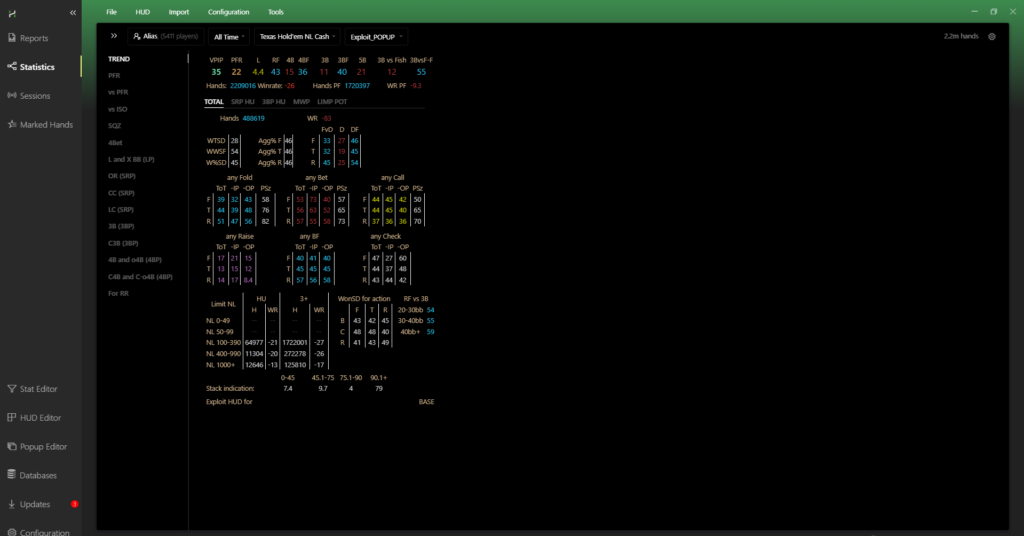
According to this data, an aggressive player has the following characteristics:
- High aggression with no decline: Aggression Frequency remains at 46% on the flop, turn, and river.
- Position does little to restrain them: on the flop, they bet 73% of the time in position and 40% out of position. On the river, they even bet more often out of position than in position: 58% versus 55%.
- Raising is a regular part of their game: 17% on the flop (21% in position), 13% on the turn, and 14% on the river.
- Their river bets often rely on bluffs: after betting the river, they win at showdown only 45% of the time. Their overall won-at-showdown percentage is also 45%, while they win 54% of pots after the flop.
In other words, an aggressive player bets considerably more often than the strength of their hands would justify. They win pots mainly by making opponents fold rather than by showing down the best hand.
Analyzing how to play against an aggressive player’s flop continuation bet
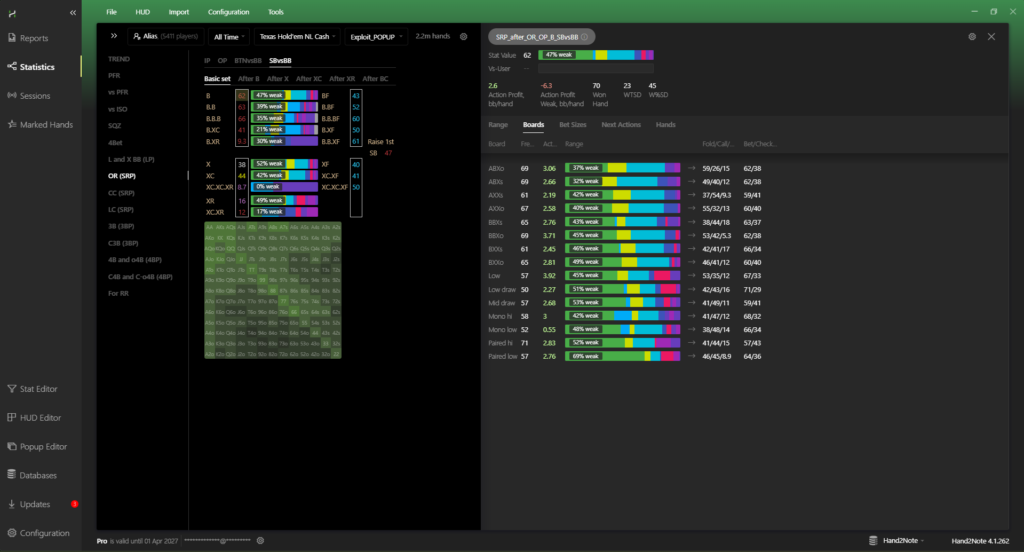
Let us consider an SB-versus-BB hand in a single-raised pot on an A♥ Q♣ 5♠ flop. In Hand2Note’s classification, this is an ABXo board: an ace, a Broadway card, and a low card in three different suits.
An aggressive player continuation-bets from the SB against the BB 62% of the time, increasing to 69% on ABXo boards. They usually give up when raised: they fold 59%, call 26%, and 3-bet 15%. In the same situation, a moderately aggressive player folded to a raise only 40% of the time, so the difference is substantial. If their continuation bet is called, the aggressive player continues betting the turn 62% of the time.
Hand2Note classifies around 37% of their continuation bets on ABXo boards as weak hands. This figure is based on revealed hole cards, so it is best treated as an approximate estimate of their range composition.
We will build our strategy in three steps:
- take the preflop ranges of both players;
- determine the range with which the aggressive opponent continuation-bets and the range with which we defend;
- calculate the equity, followed by the EV of calling and raising.
Determining the players’ preflop ranges with FreeBetRange
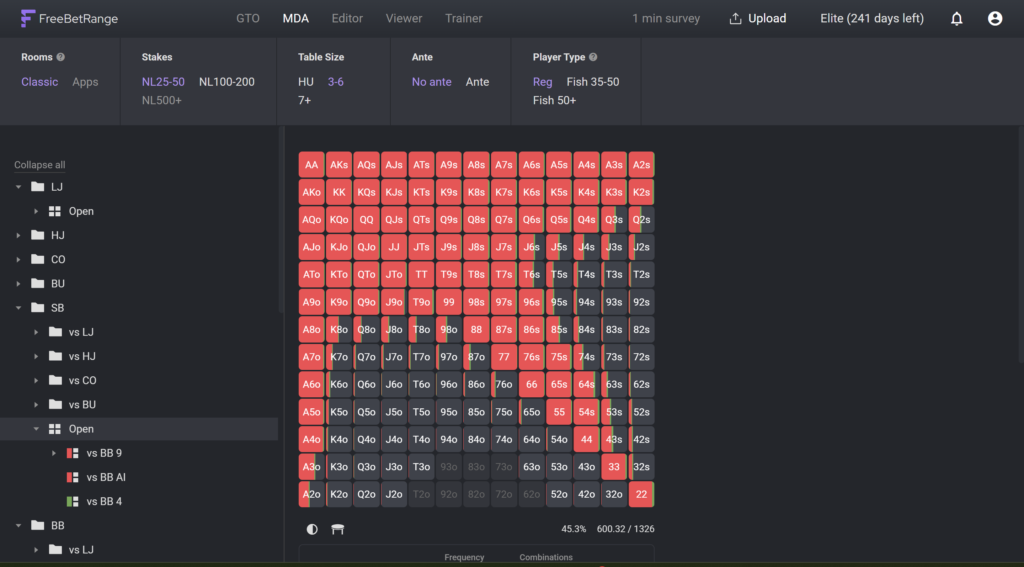
We take the preflop ranges from the MDA section of the FreeBetRange trainer. It shows how real players play each position rather than presenting solver output. The analysis settings are Classic rooms, NL25–50 stakes, 3–6 players per table, no ante, and Reg as the player type.
With these settings, the SB opens against the BB with around 45% of hands:
Facing a 2.5bb open from the SB, the player in the BB continues with 48.7% of hands. Some are played as 3-bets and others as calls:
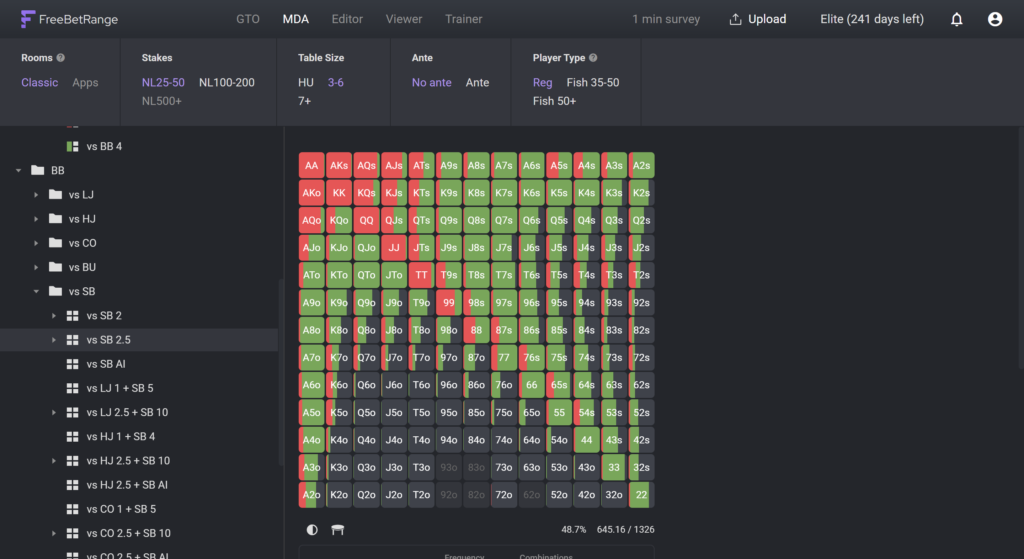
On an ace-high flop, it is important to note that the BB almost always 3-bets AK and AQ preflop. As a result, their calling range contains few strong top pairs, with most of their aces having weak kickers.
To transfer the range to a calculator, simply click Export, and it will be copied to the clipboard.
Determining hand strength with FlopZilla
We load both ranges from FreeBetRange into FlopZilla and set the flop to A♥ Q♣ 5♠.
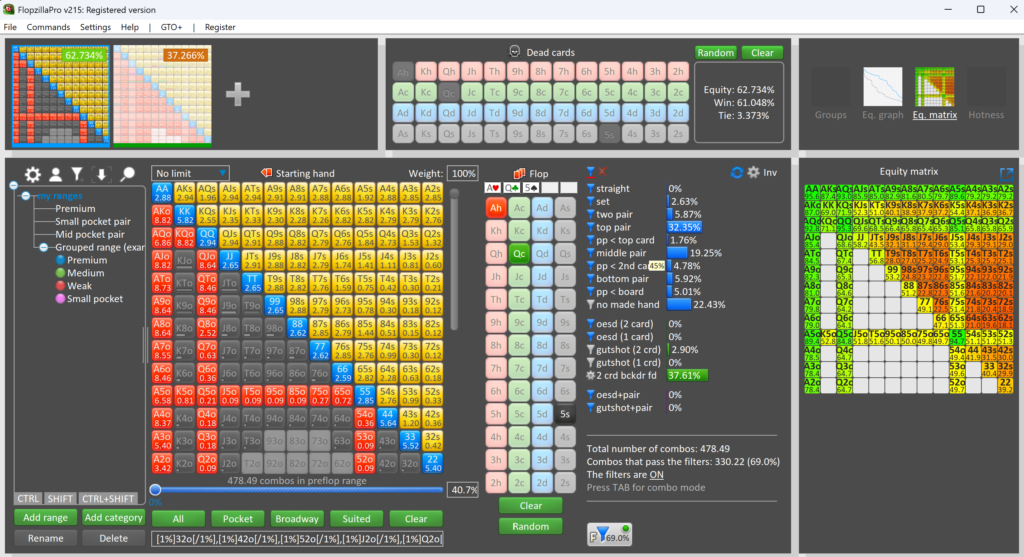
Since the aggressive player continuation-bets 69% of the time on ABXo boards, we also limit the SB’s betting range in FlopZilla to 69% of their range. This includes all of the SB’s made hands and unpaired hands, which account for 22% of the continuation-betting range. Against the BB’s calling range, this continuation-betting range has 62.7% equity.
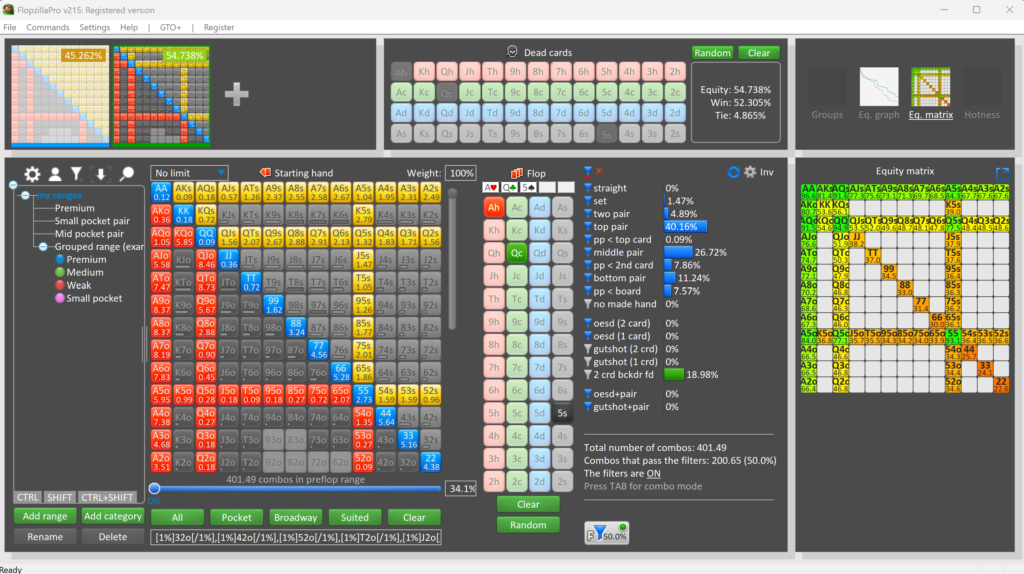
We construct the BB’s defending range in the same way as in our previous analyses of dry boards: we keep every hand with a pair or better, which accounts for exactly 50% of the calling range. We fold every unpaired hand, including the KJ, KT, and JT gutshots. This defending range has 54.7% equity against the SB’s continuation-betting range.
Calculating equity for different hand groups
We divide the BB’s defending hands into groups and calculate the equity of each group against the entire continuation-betting range, rounded to the nearest percentage point:
- Set (AA, QQ, 55) — 93% equity
- Two pair (AQ, A5, Q5) — 84% equity
- Top pair with a strong kicker (AK, AJ, AT) — 76% equity
- Top pair with a weak kicker (A9–A2) — 69% equity
- Middle pair (Qx) and KK — 50% equity
- Pocket pairs below the second-highest board card (JJ–66) — 32% equity
- Bottom pair (5x) — 36% equity
- Pocket pairs below the board (44–22) — 24% equity
There are no draws in our defending range: the dry board offers neither flush draws nor open-ended straight draws, and we do not defend unpaired hands.
These figures are not enough to evaluate a raise. The aggressive player continues against a raise 41% of the time—calling 26% and 3-betting 15%—and almost the same proportion of their continuation-betting range, 40.8%, consists of top pair or better. This means that when our raise is called, we will almost always be up against top pair or a stronger hand. In FlopZilla, we leave the SB with only sets, two pair, and top pair. These hands account for 28.2% of their opening range. We then recalculate the equity. Against this range, the BB’s defending range has only 25.3% equity:
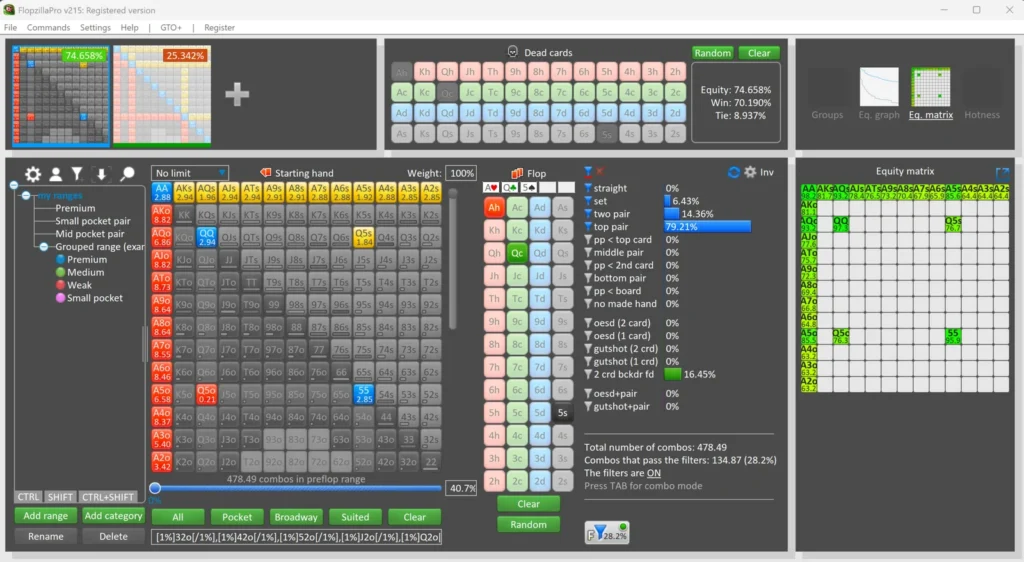
The equity of the BB’s hand groups against the range that continues versus a raise is:
- Set — 91% equity
- Two pair — 70% equity
- Top pair with a strong kicker — 53% equity
- Top pair with a weak kicker — 33% equity
- Middle pair and KK — 17% equity
- Pocket pairs below the second-highest board card — 8% equity
- Bottom pair — 18% equity
- Pocket pairs below the board — 9% equity
We will not split the continuation-betting range by bet size. Instead, we assume that the entire range uses a single sizing and test sizes ranging from 33% to 125% of the pot.
Calculating call and raise EV against different bet sizes
We calculate EV using the formulas below. Rake and rakeback are not included.
EV Call = ( Вероятность выигрыша игрока * ( Бет + Банк ) ) - ( Вероятность выигрыша противника * Бет )EV Raise = ( Вероятность фолда на рейз * ( Бет + Банк ) ) + ( Вероятность колла рейза * ( Эквити при колле рейза * ( Банк + Рейз ) - ( 1 - Эквити при колле рейза ) * Рейз ) ) - ( Вероятность трибета на рейз * Рейз )“Equity when the raise is called” means the hand’s equity against the range that continues versus a raise. A 3-bet in the formula means that we fold and lose the amount invested in the raise.
Starting values:
- the pot on the flop is 5bb (a 2.5bb open-raise from the SB and a call from the BB);
- our raise size is three times the opponent’s bet;
- fold to raise — 59%, call raise — 26%, 3-bet versus raise — 15%;
- EV is shown in big blinds.
Set: according to the table, calling outperforms raising against every bet size. However, remember that we would not fold a set to a 3-bet, while the formula assumes that we do. The actual EV of raising with this hand group is therefore higher than the values shown in the table.
| vs Bet Size | EV CALL | EV RAISE |
|---|---|---|
| BET 33% | 6.07 | 5.42 |
| BET 50% | 6.80 | 6.08 |
| BET 66% | 7.49 | 6.71 |
| BET 85% | 8.31 | 7.45 |
| BET 100% | 8.95 | 8.03 |
| BET 125% | 10.03 | 9.01 |
Two pair: calling is more profitable than raising against every sizing, and the advantage of calling only increases as the opponent’s bet gets larger.
| vs Bet Size | EV CALL | EV RAISE |
|---|---|---|
| BET 33% | 5.32 | 4.61 |
| BET 50% | 5.90 | 4.99 |
| BET 66% | 6.44 | 5.35 |
| BET 85% | 7.09 | 5.78 |
| BET 100% | 7.60 | 6.12 |
| BET 125% | 8.45 | 6.68 |
Top pair with a strong kicker: calling is again the better option. The hands that continue against a raise are mainly top pair or better, reducing our equity against them to 53%.
| vs Bet Size | EV CALL | EV RAISE |
|---|---|---|
| BET 33% | 4.66 | 3.95 |
| BET 50% | 5.10 | 4.11 |
| BET 66% | 5.52 | 4.26 |
| BET 85% | 6.01 | 4.43 |
| BET 100% | 6.40 | 4.57 |
| BET 125% | 7.05 | 4.81 |
Top pair with a weak kicker: calling is substantially more profitable. By raising, we fold out every hand weaker than ours and remain up against a range against which we have only 33% equity.
| vs Bet Size | EV CALL | EV RAISE |
|---|---|---|
| BET 33% | 4.08 | 3.17 |
| BET 50% | 4.40 | 3.07 |
| BET 66% | 4.70 | 2.97 |
| BET 85% | 5.06 | 2.85 |
| BET 100% | 5.35 | 2.75 |
| BET 125% | 5.82 | 2.60 |
Middle pair and KK: against a one-third-pot bet, calling and raising have almost the same value. From a half-pot bet upward, calling becomes more profitable. The EV of calling does not change with the sizing here because the group has exactly 50% equity.
| vs Bet Size | EV CALL | EV RAISE |
|---|---|---|
| BET 33% | 2.50 | 2.55 |
| BET 50% | 2.50 | 2.23 |
| BET 66% | 2.50 | 1.93 |
| BET 85% | 2.50 | 1.58 |
| BET 100% | 2.50 | 1.30 |
| BET 125% | 2.50 | 0.83 |
Pocket pairs below the second-highest board card: raising now generates more EV than calling. Against a 125%-pot bet, both options are unprofitable.
| vs Bet Size | EV CALL | EV RAISE |
|---|---|---|
| BET 33% | 1.01 | 2.20 |
| BET 50% | 0.70 | 1.77 |
| BET 66% | 0.41 | 1.35 |
| BET 85% | 0.07 | 0.86 |
| BET 100% | -0.20 | 0.48 |
| BET 125% | -0.65 | -0.17 |
Bottom pair: raising outperforms calling against every sizing.
| vs Bet Size | EV CALL | EV RAISE |
|---|---|---|
| BET 33% | 1.34 | 2.59 |
| BET 50% | 1.10 | 2.29 |
| BET 66% | 0.88 | 2.00 |
| BET 85% | 0.61 | 1.66 |
| BET 100% | 0.40 | 1.39 |
| BET 125% | 0.05 | 0.94 |
Pocket pairs below the board: raising is more profitable here as well. Against a 125%-pot bet, raising is approximately break-even, while calling produces a significant loss.
| vs Bet Size | EV CALL | EV RAISE |
|---|---|---|
| BET 33% | 0.34 | 2.24 |
| BET 50% | -0.10 | 1.82 |
| BET 66% | -0.52 | 1.42 |
| BET 85% | -1.01 | 0.94 |
| BET 100% | -1.40 | 0.57 |
| BET 125% | -2.05 | -0.06 |
Conclusions
The calculations do not account for rake, different bet sizes within the continuation-betting range, or turn and river play. We should therefore choose our actions with a margin of safety:
- Set: call, although raising is also profitable. Calling keeps the opponent’s bluffs in the hand. If they 3-bet after we raise, call.
- Two pair: call against every sizing.
- Top pair with a strong kicker: call against every sizing.
- Top pair with a weak kicker: call only, as raising turns the hand into a bluff.
- Middle pair and KK: against a one-third-pot bet, call or raise and fold to a 3-bet. Against bets of half the pot or more, call.
- Pocket pairs below the second-highest board card: against bets of up to 100% of the pot, raise and fold to a 3-bet. Against overbets, fold.
- Bottom pair: raise against every sizing and fold to a 3-bet.
- Pocket pairs below the board: against bets of up to 100% of the pot, raise and fold to a 3-bet. Against overbets, fold.
Against an aggressive player, hands take on the following roles: strong hands bluff-catch by calling, while weak pairs become bluffs by raising. Calling with a strong hand allows the opponent to continue their aggression on the turn and river, while raising with a weak pair exploits the fact that they fold 59% of their continuation bets when faced with pressure.
These calculations rely on several assumptions worth remembering. The call EV assumes that a hand realizes all of its equity, but weak pairs played out of position against someone who bets the turn 62% of the time rarely reach showdown. In practice, raising these hands is therefore even more profitable than the tables suggest. The opposite is true for sets and two pair: their raise EV is understated because we do not fold them to a 3-bet.
The flop decision is only the first branching point. To develop a complete strategy, the same calculations must be continued on the turn and river.
Calling the flop immediately raises new questions: we called with top pair and a weak kicker, so what comes next? After our call, the aggressive opponent bets the turn 62% of the time. Should we call the second barrel or raise if they fold to a raise around half the time after betting again? What should we do on the river if their bets on the final street win at showdown only 45% of the time?
Final thoughts
An aggressive player applies pressure on every street and from any position, but that pressure is driven more by frequency than by hand strength. They bet and raise frequently, yet win fewer than half of their showdowns.
The Aggression Frequency filters—40% or higher on the flop, 38% or higher on the turn, and 36% or higher on the river—in Hand2Note’s Multiple Players tool separate these opponents from the rest and reveal exactly where their aggression stops being profitable. The hand analysis shows how to turn this information into profit: strong hands call and allow the opponent to keep bluffing, while weak pairs raise and fold only to a 3-bet.
The calculations in FlopZilla and FreeBetRange also highlight an important technical point: when evaluating a raise, equity must be calculated against the hands that continue versus that raise. Against an aggressive player, this range is almost always top pair or better. That is why raising medium-strength hands performs worse than calling, even though the opponent folds frequently.
These conclusions apply to this specific board and sample. The figures will differ on other textures and against other opponents, so it is more useful to learn the method than to memorize the final decisions. Stats reveal an opponent’s tendencies, calculations translate those tendencies into EV, and careful attention to their actions on each street shows when those tendencies come into play.
The series does not end with the passive, moderately aggressive, and aggressive player profiles. Next, we will learn how to identify opponent types at the table automatically using Hand2Note and the Badges tool.

Latest guides
-
 Exploit Fundamentals: Aggressive Player Profile Nov 22, 2026
-
 Exploit Fundamentals: The Moderately Aggressive Player Profile Nov 22, 2026
-
 How to Use Hand2Note on Mac: Complete macOS Guide Oct 5, 2026
-
 Exploit Basics: Passive Player Profile Apr 9, 2026
-
 Hand2Note Popup Editor: Creating a Professional Popup Mar 28, 2026
We regularly publish new Hand2Note 4 guides on our Discord server.
Join Discord Server