Why Aggression from Passive Fish is Dangerous

Every poker player has encountered a situation where there is a passive fish (a known bad poker player, amateur) at the table, who rarely raises, calls a lot, and prefers to check. Their VPIP (Voluntarily Put Money in Pot percentage preflop) is high, and PFR (Preflop Raise percentage) is low, making it seem easy to win against them. However, these players often cause the most painful losses—when they suddenly show aggression, many do not believe their actions and make mistakes, thinking it is a bluff.
This article discusses how to analyze the play of passive fish using the Multiple Players tool in Hand2Note. This will not only allow you to see the statistics but also understand the essence of their dangerous play: when and why their sudden aggression almost always means the nuts (one of the strongest possible hands in the game). A step-by-step analysis will reveal the main question: why you should fear aggression from passive fish.
Why Are Passive Fish Dangerous?
Before moving on to the analysis, it is important to understand the main tendencies of passive fish play:
- Fish — typically a player with a high VPIP (45%+) and low PFR (less than 15%). The difference between VPIP and PFR is large (e.g., VPIP = 55, PFR = 12).
- Passive. Aggression from them is rare. Due to their overall passivity, when such a player suddenly starts raising, betting, or responding with an all-in (a bet equal to the player’s entire stack), they rarely do so with a bluff or weak hand. Their range of actions narrows to strong combinations and nut draws. Typically, such a player has an Aggression Frequency (aggression frequency) below 30 percent on each of the postflop streets.
A typical mistake when playing against a passive fish is getting used to their passivity and perceiving the table as a source of easy money. When they show aggression, there is disbelief that such a player can have a strong hand, which often leads to losses in hands.
The goal of the analysis is to prove with data that aggression from a passive player is a red flag, ignoring which costs money.
Creating a Target Group of Passive Fish Using Hand2Note
The first step is to create a model of a typical “passive fish” in Hand2Note by grouping similar players together.

- First, open Hand2Note and go to the “Statistics“ section, and in the top left corner, click on “Multiple Players”.
- In the window that opens, set up filters in the “BASE STATS” block:
- Hands: Set a minimum of 500 hands. This provides a sufficient sample for analysis.
- VPIP: Since we need fish, set VPIP from 45%.
- VPIP-PFR: Set a minimum of 30. This automatically selects players with a large difference between VPIP and PFR, i.e., classic passive preflop callers.
- For the purity of the experiment, in the “WINNINGS” block, you can set the filter “Win Rate EV, bb/100” less than 0. This additionally allows filtering out losing players (fish) rather than loose regulars (professional poker players who prefer a wide range of starting hands preflop).
- To find passive players specifically (with Aggression Frequency less than 30 percent on each of the postflop streets), you need to:
- Below – on the right, switch the method of additional filtering by stats from the Hand2Note configuration to “Textual mode“.
- Enter a formula in the input field that indicates only those players whose Aggression Frequency Flop is less than 30, Aggression Frequency Turn is less than 30, and Aggression Frequency River is less than 30.
- Ensure the correctness of the formula by displaying a green checkmark in the lower-left corner of the formula input window.
- Click “APPLY” to combine the statistics of all players matching the specified criteria into one.

In this article, the formula for finding passive players was composed based on the basic stats configuration of Hand2Note. You can create your own formula based on poker logic. More about formula composition methods is discussed in the articles “Multiple Players in Hand2Note“ and “Creating Complex Stats.”
The formula for finding passive players used in the article (it will work in any Hand2Note configuration that includes basic stats):
(Cases(Flop Raise or Bet) / Cases(Flop Any Action) * 100) < 30 and (Cases(Turn Raise or Bet) / Cases(Turn Any Action) * 100) < 30 and (Cases(River Raise or Bet) / Cases(River Any Action) * 100) < 30After the calculation is complete, Hand2Note will display an active popup (in the example shown, a popup developed by the project: “Exploit HUD”) with a summary of all players matching the specified criteria, presented as a single profile.

Analyzing Aggression Patterns of Passive Fish on the Postflop
If you look at the “Any Bet” and “Any Raise” blocks, you can see that passive fish very rarely make a bet on the postflop or raise.
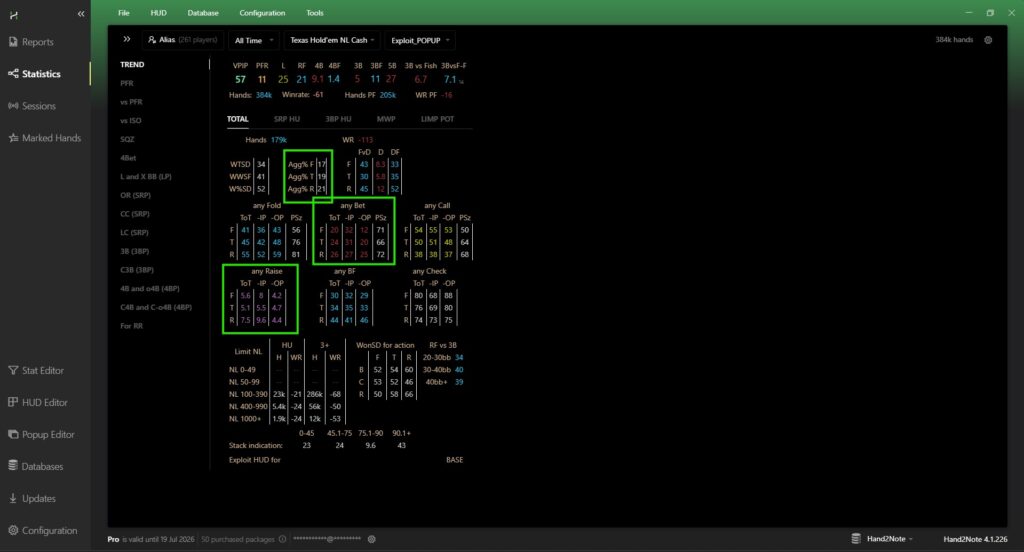
The percentage of flop bets in position (the player acts last on the street) for a passive fish is 32 percent, turn — 31 percent, river — 27 percent. Out of position (the player acts first on the street), the passive fish bets even less: 12 percent on the flop, 20 percent on the turn, and 25 percent on the river. This means the player tends to prefer checking on the postflop rather than aggressive action — betting.
By left-clicking on any of these stats, you can study the strength of the player’s hands when they perform the actions outlined in the stat. The data filling and clarifications are built from the actions taken by the player and the hands they revealed at showdown.
Analyzing “bet-flop in position”, you can notice that passive fish in this situation choose to bet mainly for strong hands and draws, almost not using bluffs with low chances of winning and ready weak hands.

On the turn and river, the situation changes even more clearly towards strong hands when a passive fish bets:


When raising on the postflop, a passive fish chooses even stronger and rarer ranges of strong hands:


Thus, it becomes obvious: aggression from a passive player is almost always a signal indicating a strong hand. Their play line is conservative and predictable: they wait until they are confident in their strength and only then take aggressive action.
Practical Conclusion and Strategy Adjustment
So, the data is collected and analyzed. What to do with this information?
- Reconsider your calls. Next time a passive player bets or raises, remember this analysis. Top pair with a weak kicker or second pair against their range is often a loss. Folding becomes the right decision.
- Use aggression against passive fish correctly. Since they rarely raise without a strong hand, you can more often apply controlled aggression. Make continuation bets on favorable boards, knowing they will fold most hands or, conversely, try to call with unprepared hands. But it’s important to be ready to give up if they suddenly show aggression in response.
- Add a label. Returning to the “Multiple Players” window, you can find real opponents from the database that fit the criteria of passive fish and mark them with a colored marker (e.g., red or green). Now at the table, you can immediately recognize them and adjust your strategy.

Conclusion: Data vs. Illusions
Analysis through “Multiple Players” removes the veil of mystery from the play of passive fish. What was previously considered random luck or illogical action turns out to be a clear, strength-driven pattern.
Their aggression is not dangerous in itself. The danger lies in the unwillingness to believe it. Using Hand2Note not just for collecting statistics but for deep studying of behavior patterns helps turn losing calls against “unexpected” aggression into confident folds, positively affecting the graph.
Main conclusion: If a passive fish suddenly starts biting, it means they already have teeth. And these teeth are a ready nut combination. Do not test their strength.

Latest guides
-

 Hand2Note Pro Pricing Reduced in 2026 Mar 19, 2026
 -
 How to Analyze Fish Ranges: Limp, Limp-Raise, and Limp-Fold Mar 13, 2026
 -
 Hand2Note Popup Editor: Creating a Simple Popup Mar 10, 2026
 -
 Hand2Note 4.1: Overview of key updates 2025–2026 Mar 10, 2026
 -
 Hand2Note HUD Not Showing? Complete Troubleshooting Guide Mar 10, 2026
We regularly publish new Hand2Note 4 guides on our Discord server.
Join Discord Server