Exploit Strategies Are Taking Over GTO: What Are You Missing?

In modern poker, GTO became common knowledge — and stopped being an edge. Ten years ago, knowing GTO was an edge in itself. Today it’s the price of admission. Solvers moved into the browser, libraries of millions of presolves sit in open access, and trainers drill you through the decision tree until you answer to within a percentage point.
And here’s where the fundamental thing surfaces — the thing everyone knew but preferred to ignore for a long time: GTO is a strategy against a perfect opponent who isn’t at the table. Equilibrium guarantees you won’t get exploited. But that same equilibrium forces you to give up profitable lines — just to stay “unexploitable” against people who aren’t even trying to exploit you. You mix bluffs and bluff-catchers at equilibrium frequencies, while your opponent is overfolding 68% in a spot where he should fold 45%. Every unprocessed leak like that is lost EV.
The conclusion the industry arrived at: the money isn’t in the equilibrium, it’s in the pool’s deviations from it. And to systematically find those deviations, you don’t need yet another solver — you need data on how real players actually play.
What’s happening: the pivot toward MDA
The key acronym of the new meta is MDA (Mass Data Analysis). The idea is simple: take millions of real hands, split players by archetype (reg, fish, maniac, nit) and by game conditions (room, stake, table size), and look at the ranges and frequencies the pool has at every node of the tree. Then you build a counter-strategy against that exact distribution, rather than against an abstract perfect player.
This changes the study loop itself. Before: “open a solver → learn the equilibrium line → repeat it at the table.” Now: “look at how the pool deviates → build the exploit → check that it doesn’t fall apart if the opponent adapts.” GTO stays the baseline and the safety net, but the center of gravity has shifted to population modeling.
Tellingly, even the flagships of the GTO segment moved in this direction. In the fall of 2025, GTO Wizard rolled out Player Profiles — the ability to model an opponent with persistent leaks (a calling station, a maniac, a nit) and immediately compute the best response. The developer itself calls this “a new approach to studying exploitative poker.” When the planet’s main GTO trainer adds tools for exploits, you can consider the trend established.
The tools: what to work with
Below is a working arsenal for exploitative play, from collecting data to building counter-strategies.
1. Hand2Note — the foundation of population analysis
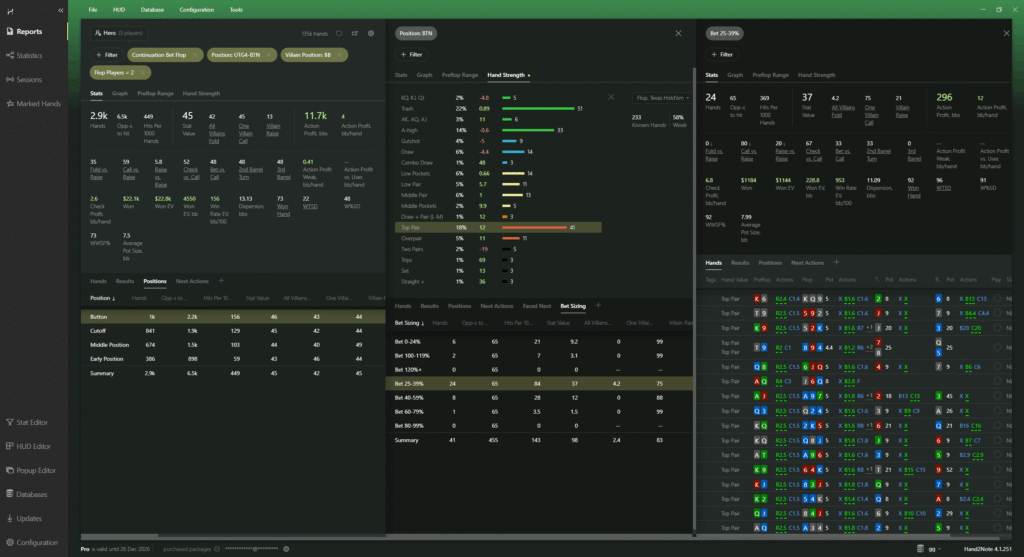
The tracker that essentially made population analysis mainstream. Its signature feature is Multiple Player Reports, which lets you build MDA reports over million-hand databases in seconds and study opponents’ tendencies in fine detail. On top of that come advanced HUDs and popups, so you also have all the necessary information on your opponents right at hand during play — with the ability to quickly assign them to the right player type and run profitable exploits against them. This is your entry point: here you see exactly where the pool leaks.
2. GTO Wizard AI (Profiles) — exploits inside the GTO flagship
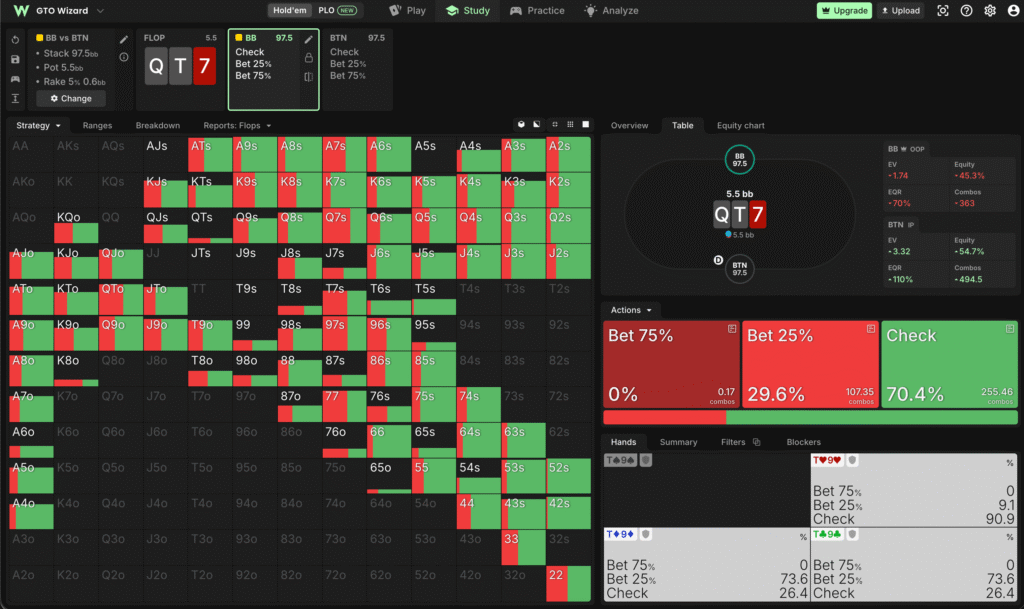
An exploit-oriented feature inside the GTO flagship. Player Profiles let you attach a profile with persistent leaks to an opponent and get the optimal counter-response in any solvable spot. Profiles work through action “incentives” (“this player likes betting” / “tends to check”), and the engine propagates that bias across the tree — the result is a practical exploit that doesn’t go off the rails. An important limitation: for now it works within a single street (there’s no multi-street tree for this mechanic). On the developer’s roadmap — knobs for bluff frequencies and modeling human play directly from hand history. This is convenient for those who already live in the Wizard ecosystem and don’t want to move into separate software.
3. Freebetrange MDA — the pool’s preflop ranges
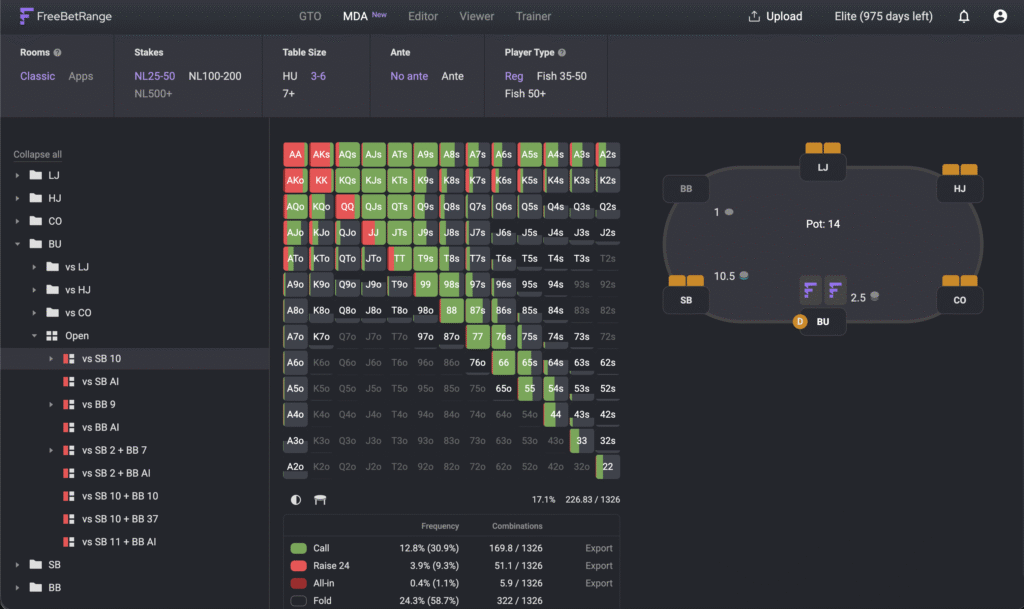
Where Hand2Note and GTO Wizard shine postflop, Freebetrange is the go-to tool for preflop. Its MDA section gives you ready-made population preflop ranges based on 300M+ real cash hands. You pick a player archetype and walk through its decision tree spot by spot, filtering by room, stake, table size, ante. Any range exports in one click — load it into a solver and compute the best response against that exact range. The dataset refreshes every six months so the pool’s tendencies don’t go stale. And alongside it sits the best preflop chart builder on the market plus a trainer, so you can drill the exploits you’ve found into muscle memory.
Bonus: Classic solvers with node-locking — the “manual” exploit
Don’t write off the old school either. PioSolver, GTO+, MonkerSolver let you, via node-locking, manually fix an opponent’s mistaken frequency at a node and see how the optimal response changes. It’s slower and requires that you yourself know what to lock (and this is exactly where the data from Hand2Note and Freebetrange comes in handy), but it gives full control. From the recent crop — Rocket Solver puts node-locking front and center as its main workflow. In essence, node-locking is the same exploitative approach, you just feed in the pool data by hand.
How to put this into a workflow
- Find the leak. In Hand2Note (or FreeBetRange MDA), identify where the pool systematically deviates from equilibrium — an overfold on the river, an under-3-bet, a too-frequent c-bet.
- Quantify it. Export the pool’s real range/frequency at that node.
- Build the counter-strategy. Feed the data into a node-lock (Pio / Rocket) or into a specialized engine (Profiles in GTO Wizard) and get the maximally exploitative response.
- Stress-test it. Make sure the exploit doesn’t fall apart if the opponent adapts a little. Sharp shifts (like “value only with the nuts, everything else as a bluff”) are profitable but dangerous: misread the spot, and you’re the one being exploited.
- Drill it into muscle memory. Through a trainer (FreeBetRange, GTO Wizard), bring the new lines to automatic at the table — otherwise all the analysis stays on paper.
Bottom line
GTO hasn’t gone anywhere — it remains a mandatory baseline and a safety net against strong opponents. But as a source of edge, equilibrium has exhausted itself: everyone owns it. The real money has shifted to where the pool deviates from the optimum, and the only way to systematically find that is data. The chain “tracker to find leaks → MDA platform to quantify them → solver/AI to build the counter-strategy → trainer to lock it in” is the new standard of preparation. Whoever learns first to turn population data into concrete lines at the table is the one who takes the difference.

Purchase Hand2Note with 10% discount and get exclusive bonuses: